FEFreeExamDumps.in

AB-100 Practice Questions — Page 10

Note: This section contains one or more sets of questions with the same scenario and problem. Each question presents a unique solution to the problem. You must determine whether the solution meets the stated goals. More than one solution in the set might solve the problem. It is also possible that none of the solutions in the set solve the problem.

After you answer a question in this section, you will NOT be able to return. As a result, these questions do not appear on the Review Screen.

A company has a team that analyzes its customers by using a manual process.

You are designing an AI-based agent to automate and improve the process.

You need to recommend on which platform to build the agent. The solution must meet the following requirements:

• Use generative AI to answer common questions.

• Provide analytics to review AI performance.

• Identify customer demographics.

• Minimize custom development.

Solution: You recommend GitHub Copilot.

Does this meet the goal?

  • A.Yes
  • B.No ✓

Note: This section contains one or more sets of questions with the same scenario and problem. Each question presents a unique solution to the problem. You must determine whether the solution meets the stated goals. More than one solution in the set might solve the problem. It is also possible that none of the solutions in the set solve the problem.

After you answer a question in this section, you will NOT be able to return. As a result, these questions do not appear on the Review Screen.

A company has a team that analyzes its customers by using a manual process.

You are designing an AI-based agent to automate and improve the process.

You need to recommend on which platform to build the agent. The solution must meet the following requirements:

• Use generative AI to answer common questions.

• Provide analytics to review AI performance.

• Identify customer demographics.

• Minimize custom development.

Solution: You recommend Microsoft Security Copilot.

Does this meet the goal?

  • A.Yes
  • B.No ✓

Note: This section contains one or more sets of questions with the same scenario and problem. Each question presents a unique solution to the problem. You must determine whether the solution meets the stated goals. More than one solution in the set might solve the problem. It is also possible that none of the solutions in the set solve the problem.

After you answer a question in this section, you will NOT be able to return. As a result, these questions do not appear on the Review Screen.

A company has a team that analyzes its customers by using a manual process.

You are designing an AI-based agent to automate and improve the process.

You need to recommend on which platform to build the agent. The solution must meet the following requirements:

• Use generative AI to answer common questions.

• Provide analytics to review AI performance.

• Identify customer demographics.

• Minimize custom development.

Solution: You recommend Microsoft Copilot Studio.

Does this meet the goal?

  • A.Yes ✓
  • B.No

A company uses multiple Microsoft Copilot Studio agents across different channels.

You need to recommend a monitoring solution that provides comprehensive telemetry data and performance insights for the agents.

What should you include in the recommendation?

  • A.Microsoft Power BI
  • B.the Analytics tab in Copilot Studio
  • C.Log Analytics
  • D.Azure Advisor

Case study

This is a case study. Case studies are not timed separately from other exam sections. You can use as much exam time as you would like to complete each case study. However, there might be additional case studies or other exam sections. Manage your time to ensure that you can complete all the exam sections in the time provided. Pay attention to the Exam Progress at the top of the screen so you have sufficient time to complete any exam sections that follow this case study.

To answer the case study questions, you will need to reference information that is provided in the case. Case studies and associated questions might contain exhibits or other resources that provide more information about the scenario described in the case. Information provided in an individual question does not apply to the other questions in the case study.

A Review Screen will appear at the end of this case study. From the Review Screen, you can review and change your answers before you move to the next exam section. After you leave this case study, you will NOT be able to return to it.

To start the case study

To display the first question in this case study, select the "Next" button. To the left of the question, a menu provides links to information such as business requirements, the existing environment, and problem statements. Please read through all this information before answering any questions. When you are ready to answer a question, select the "Question" button to return to the question.

Background

Fabrikam, Inc., is a global consumer goods company that is undergoing a digital transformation initiative to migrate its entire infrastructure to the Microsoft cloud. As a key element of this cloud migration, the company will implement Microsoft Dynamics 365 Sales, moving away from the current on-premises proprietary technologies used by its business-to-business (B2B) sales team.

As part of the cloud migration, Fabrikam will adopt an AI-first approach to its business solutions and implement AI solutions, wherever possible, to streamline operations.

Problem Statements

Fabrikam's infrastructure currently relies on various on-premises systems that require sales executives to use corporate computers with physical keyboards to access business information during customer interactions. Mobile phones cannot be used for these purposes, as the systems depend on keyboard input. As a result, the sales executives spend a lot of time using keyboards to search for data on several disparate systems and file servers, rather than focusing on the customers. This affects the customer experience.

Fabrikam stakeholders are concerned that users will be hesitant to adopt AI. If the AI initiatives are NOT adopted, cost savings will never be realized. Additionally, funding for future AI initiatives will depend on demonstrating an increase in AI adoption month over month. As the AI agent initiative for the sales team will be the first for Fabrikam, the rapid adoption of the agent is a high priority.

Planned Initiatives

General

Fabrikam management has prioritized AI-driven projects to improve efficiency, customer engagement, and responsible AI adoption. The current application infrastructure is on-premises and must be migrated to the cloud to support the adoption of these technologies.

Infrastructure Migration

Fabrikam plans to migrate from its current on-premises infrastructure to a completely cloud-based topology; this will include user authentication, the security framework, and, primarily, the adoption of the services by end users.

All the data from the different systems will be consolidated into a single data source - a common data model that will use a Microsoft Dataverse environment as a single source of truth (SSOT) for the sales team.

Sales Cycle Enablement

To achieve the company's objectives, Fabrikam intends to implement the following strategies to enhance the sales cycle:

Use low-code development to create a single AI agent that has Dataverse as its core component.

Ensure that sales managers can access unanswered correspondence from prospects and intervene as appropriate.

Replace the previous proprietary software with Dynamics 365 Sales to track sales cycles and customer interactions.

Have the sales executives use Dynamics 365 Sales to track interactions for open opportunities and send follow-up communications to prospects.

Have the sales executives use handsfree headsets to interact with an AI agent when they have questions about internal policies or customer data.

Requirements

Infrastructure Migration

Fabrikam has identified the following infrastructure migration requirements:

Azure must be used for all future infrastructure workloads.

The company must follow Microsoft-recommended methodologies for infrastructure migration to the cloud.

Any created AI agents must have their return on investment (ROI) calculated to ensure that the solution will save the company money.

Sales Cycle Enablement

Fabrikam has identified the following requirements for sales cycle enablement:

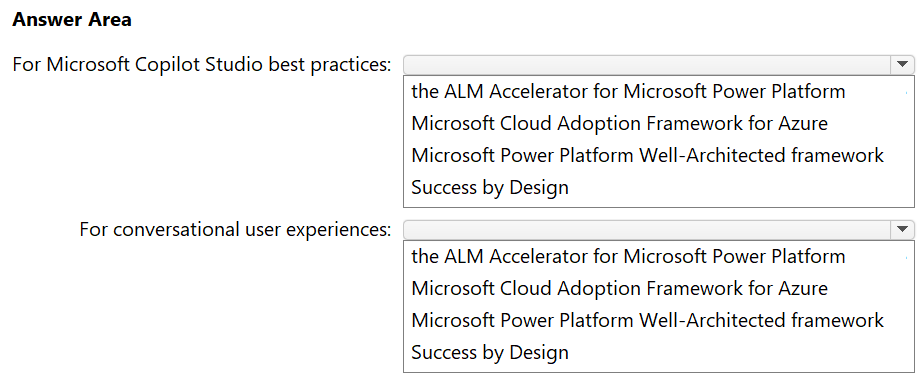
The final AI agent must follow Microsoft recommendations for a conversational user experience.

A designated checklist must be reviewed to ensure that the AI agent follows Microsoft deployment recommendations for a compliant solution.

Detailed telemetry must be logged for the first created AI agent to help troubleshoot and optimize the agent during the initial AI agent adoption process.

Unexpected AI agent actions must end in an escalation to a live representative. For example, a sales executive must be rerouted to a representative if the agent cannot answer a question after two failed attempts.

The return on investment (ROI) of switching from the current process to the future process is required for stakeholder sign off.

The sales team must use Dynamics 365 Sales to correspond with prospects more quickly and efficiently than currently.

Sales managers must report on the adoption of the AI agent to key Fabrikam stakeholders on a monthly basis.

Any sensitive information, such as user IDs and names, shared via the AI agent must be tracked for future auditing.

Which framework should you use to meet the AI agent requirements for the sales cycle enablement? To answer, select the appropriate options in the answer area.

NOTE: Each correct selection is worth one point.
Question 95

Case study

This is a case study. Case studies are not timed separately from other exam sections. You can use as much exam time as you would like to complete each case study. However, there might be additional case studies or other exam sections. Manage your time to ensure that you can complete all the exam sections in the time provided. Pay attention to the Exam Progress at the top of the screen so you have sufficient time to complete any exam sections that follow this case study.

To answer the case study questions, you will need to reference information that is provided in the case. Case studies and associated questions might contain exhibits or other resources that provide more information about the scenario described in the case. Information provided in an individual question does not apply to the other questions in the case study.

A Review Screen will appear at the end of this case study. From the Review Screen, you can review and change your answers before you move to the next exam section. After you leave this case study, you will NOT be able to return to it.

To start the case study

To display the first question in this case study, select the "Next" button. To the left of the question, a menu provides links to information such as business requirements, the existing environment, and problem statements. Please read through all this information before answering any questions. When you are ready to answer a question, select the "Question" button to return to the question.

Background

Fabrikam, Inc., is a global consumer goods company that is undergoing a digital transformation initiative to migrate its entire infrastructure to the Microsoft cloud. As a key element of this cloud migration, the company will implement Microsoft Dynamics 365 Sales, moving away from the current on-premises proprietary technologies used by its business-to-business (B2B) sales team.

As part of the cloud migration, Fabrikam will adopt an AI-first approach to its business solutions and implement AI solutions, wherever possible, to streamline operations.

Problem Statements

Fabrikam's infrastructure currently relies on various on-premises systems that require sales executives to use corporate computers with physical keyboards to access business information during customer interactions. Mobile phones cannot be used for these purposes, as the systems depend on keyboard input. As a result, the sales executives spend a lot of time using keyboards to search for data on several disparate systems and file servers, rather than focusing on the customers. This affects the customer experience.

Fabrikam stakeholders are concerned that users will be hesitant to adopt AI. If the AI initiatives are NOT adopted, cost savings will never be realized. Additionally, funding for future AI initiatives will depend on demonstrating an increase in AI adoption month over month. As the AI agent initiative for the sales team will be the first for Fabrikam, the rapid adoption of the agent is a high priority.

Planned Initiatives

General

Fabrikam management has prioritized AI-driven projects to improve efficiency, customer engagement, and responsible AI adoption. The current application infrastructure is on-premises and must be migrated to the cloud to support the adoption of these technologies.

Infrastructure Migration

Fabrikam plans to migrate from its current on-premises infrastructure to a completely cloud-based topology; this will include user authentication, the security framework, and, primarily, the adoption of the services by end users.

All the data from the different systems will be consolidated into a single data source - a common data model that will use a Microsoft Dataverse environment as a single source of truth (SSOT) for the sales team.

Sales Cycle Enablement

To achieve the company's objectives, Fabrikam intends to implement the following strategies to enhance the sales cycle:

Use low-code development to create a single AI agent that has Dataverse as its core component.

Ensure that sales managers can access unanswered correspondence from prospects and intervene as appropriate.

Replace the previous proprietary software with Dynamics 365 Sales to track sales cycles and customer interactions.

Have the sales executives use Dynamics 365 Sales to track interactions for open opportunities and send follow-up communications to prospects.

Have the sales executives use handsfree headsets to interact with an AI agent when they have questions about internal policies or customer data.

Requirements

Infrastructure Migration

Fabrikam has identified the following infrastructure migration requirements:

Azure must be used for all future infrastructure workloads.

The company must follow Microsoft-recommended methodologies for infrastructure migration to the cloud.

Any created AI agents must have their return on investment (ROI) calculated to ensure that the solution will save the company money.

Sales Cycle Enablement

Fabrikam has identified the following requirements for sales cycle enablement:

The final AI agent must follow Microsoft recommendations for a conversational user experience.

A designated checklist must be reviewed to ensure that the AI agent follows Microsoft deployment recommendations for a compliant solution.

Detailed telemetry must be logged for the first created AI agent to help troubleshoot and optimize the agent during the initial AI agent adoption process.

Unexpected AI agent actions must end in an escalation to a live representative. For example, a sales executive must be rerouted to a representative if the agent cannot answer a question after two failed attempts.

The return on investment (ROI) of switching from the current process to the future process is required for stakeholder sign off.

The sales team must use Dynamics 365 Sales to correspond with prospects more quickly and efficiently than currently.

Sales managers must report on the adoption of the AI agent to key Fabrikam stakeholders on a monthly basis.

Any sensitive information, such as user IDs and names, shared via the AI agent must be tracked for future auditing.

Which framework should you use for the infrastructure migration?

  • A.Microsoft Cloud Adoption Framework for Azure
  • B.Success by Design
  • C.Microsoft Power Platform Center of Excellence (CoE)
  • D.Microsoft Power Platform Project Setup Wizard

A company has a Microsoft 365 tenant in Canada and multiple Microsoft Power Platform environments in Canada and the United States.

The company plans to deploy a Microsoft Copilot Studio agent to the Canadian environment that will use:

• Microsoft Dataverse data stored in Canada

• A connector that connects to an Azure OpenAI instance in the United States

You need to ensure that the agent adheres to data residency and data movement policies before being deployed.

What should you do?

  • A.Ensure that the data processed by Azure OpenAI is stored in the United States.
  • B.From the Microsoft Purview portal, validate the Data loss prevention settings.
  • C.Migrate the tenant to the United States.
  • D.Ensure that cross-region data movement is enabled for the Canadian environment and connector dependencies.

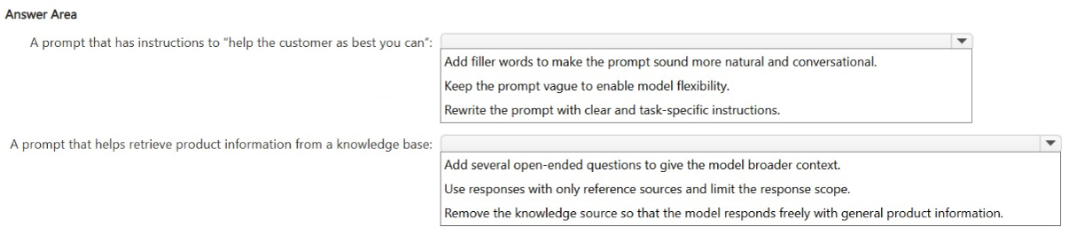
A company has a Microsoft Copilot Studio agent for customer support.

You are reviewing and validating the following prompts:

• A prompt that has instructions to "help the customer as best you can"

• A prompt that helps retrieve product information from a knowledge base

You need to ensure that the agent delivers consistent and accurate responses.

What should you do for each prompt? To answer, select the appropriate options in the answer area.

NOTE: Each correct selection is worth one point.
Question 98

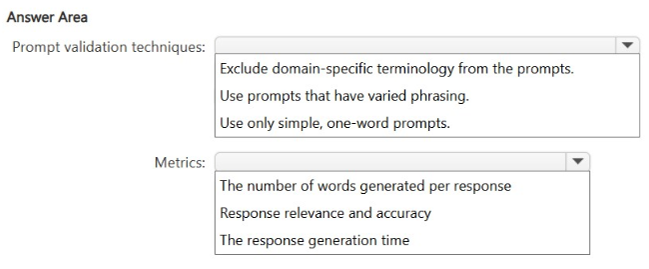
You are designing a testing solution for Microsoft Copilot Studio agents.

You need to validate prompt engineering best practices to ensure that the agents generate accurate and contextually relevant responses.

Which prompt validation techniques and metrics should you include in the solution? To answer, select the appropriate options in the answer area.

NOTE: Each correct selection is worth one point.
Question 99

Question 100

Open question ↗

A company has a Microsoft Power Platform environment that contains Microsoft Dataverse data.

You create a Microsoft Copilot Studio agent named Agent1 that processes the Dataverse data.

You discover that Agent1 fails to return relevant or accurate results.

You need to improve the quality and reliability of data grounding.

What should you do?

  • A.Retrain Agent1.
  • B.Verify and cleanse the Dataverse data.
  • C.Use an adaptive card in Agent1.
  • D.Add example user inputs to the training data of Agent1.