FEFreeExamDumps.in

AZ-104 Practice Questions — Page 4

Your company has an Azure Active Directory (Azure AD) subscription.

You need to deploy five virtual machines (VMs) to your company's virtual network subnet.

The VMs will each have both a public and private IP address. Inbound and outbound security rules for all of these virtual machines must be identical.

Which of the following is the least amount of network interfaces needed for this configuration?

  • A.5
  • B.10
  • C.20
  • D.40

Your company has an Azure Active Directory (Azure AD) subscription.

You need to deploy five virtual machines (VMs) to your company's virtual network subnet.

The VMs will each have both a public and private IP address. Inbound and outbound security rules for all of these virtual machines must be identical.

Which of the following is the least amount of security groups needed for this configuration?

  • A.4
  • B.3
  • C.2
  • D.1

Your company's Azure subscription includes Azure virtual machines (VMs) that run Windows Server 2016.

One of the VMs is backed up every day using Azure Backup Instant Restore.

When the VM becomes infected with data encrypting ransomware, you decide to recover the VM's files.

Which of the following is TRUE in this scenario?

  • A.You can only recover the files to the infected VM.
  • B.You can recover the files to any VM within the company's subscription.
  • C.You can only recover the files to a new VM.
  • D.You will not be able to recover the files.

Your company's Azure subscription includes Azure virtual machines (VMs) that run Windows Server 2016.

One of the VMs is backed up every day using Azure Backup Instant Restore.

When the VM becomes infected with data encrypting ransomware, you are required to restore the VM.

Which of the following actions should you take?

  • A.You should restore the VM after deleting the infected VM.
  • B.You should restore the VM to any VM within the company's subscription.
  • C.You should restore the VM to a new Azure VM.
  • D.You should restore the VM to an on-premise Windows device.

You administer a solution in Azure that is currently having performance issues.

You need to find the cause of the performance issues pertaining to metrics on the Azure infrastructure.

Which of the following is the tool you should use?

  • A.Azure Traffic Analytics
  • B.Azure Monitor
  • C.Azure Activity Log
  • D.Azure Advisor

Your company has an Azure subscription that includes a Recovery Services vault.

You want to use Azure Backup to schedule a backup of your company's virtual machines (VMs) to the Recovery Services vault.

Which of the following VMs can you back up? Choose all that apply.

  • A.VMs that run Windows 10.
  • B.VMs that run Windows Server 2012 or higher.
  • C.VMs that have NOT been shut down.
  • D.VMs that run Debian 8.2+.
  • E.VMs that have been shut down.

Note: This question is part of a series of questions that present the same scenario. Each question in the series contains a unique solution that might meet the stated goals. Some question sets might have more than one correct solution, while others might not have a correct solution.

After you answer a question in this section, you will NOT be able to return to it. As a result, these questions will not appear in the review screen.

You have an Azure Active Directory (Azure AD) tenant named contoso.com.

You have a CSV file that contains the names and email addresses of 500 external users.

You need to create a guest user account in contoso.com for each of the 500 external users.

Solution: You create a PowerShell script that runs the New-AzureADUser cmdlet for each user.

Does this meet the goal?

  • A.Yes
  • B.No

Note: This question is part of a series of questions that present the same scenario. Each question in the series contains a unique solution that might meet the stated goals. Some question sets might have more than one correct solution, while others might not have a correct solution.

After you answer a question in this section, you will NOT be able to return to it. As a result, these questions will not appear in the review screen.

You have an Azure Active Directory (Azure AD) tenant named contoso.com.

You have a CSV file that contains the names and email addresses of 500 external users.

You need to create a guest user account in contoso.com for each of the 500 external users.

Solution: From Azure AD in the Azure portal, you use the Bulk create user operation.

Does this meet the goal?

  • A.Yes
  • B.No

Note: This question is part of a series of questions that present the same scenario. Each question in the series contains a unique solution that might meet the stated goals. Some question sets might have more than one correct solution, while others might not have a correct solution.

After you answer a question in this section, you will NOT be able to return to it. As a result, these questions will not appear in the review screen.

You have an Azure Active Directory (Azure AD) tenant named contoso.com.

You have a CSV file that contains the names and email addresses of 500 external users.

You need to create a guest user account in contoso.com for each of the 500 external users.

Solution: You create a PowerShell script that runs the New-AzureADMSInvitation cmdlet for each external user.

Does this meet the goal?

  • A.Yes
  • B.No

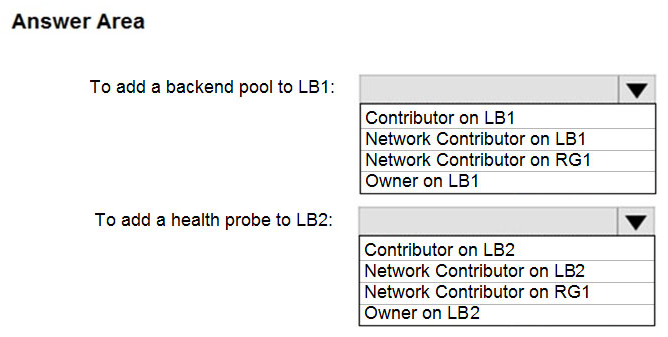
You have an Azure subscription named Subscription1 that contains a resource group named RG1.

In RG1, you create an internal load balancer named LB1 and a public load balancer named LB2.

You need to ensure that an administrator named Admin1 can manage LB1 and LB2. The solution must follow the principle of least privilege.

Which role should you assign to Admin1 for each task? To answer, select the appropriate options in the answer area.

NOTE: Each correct selection is worth one point.

Hot Area:

Question 40