FEFreeExamDumps.in

AZ-204 Practice Questions — Page 11

Question 101

Open question ↗

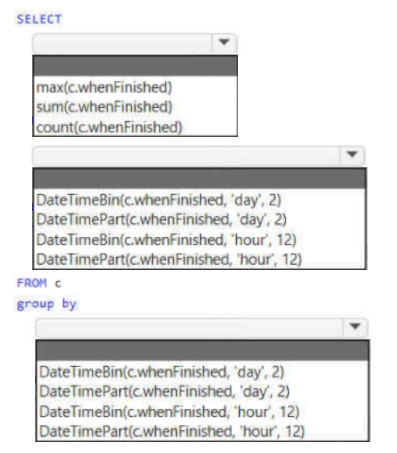
You develop an application that sells AI generated images based on user input. You recently started a marketing campaign that displays unique ads every second day.

Sales data is stored in Azure Cosmos DB with the date of each sale being stored in a property named ‘whenFinished’.

The marketing department requires a view that shows the number of sales for each unique ad.

You need to implement the query for the view.

How should you complete the query? To answer, select the appropriate options in the answer area.

NOTE: Each correct selection is worth one point.
Question 101

Question 102

Open question ↗

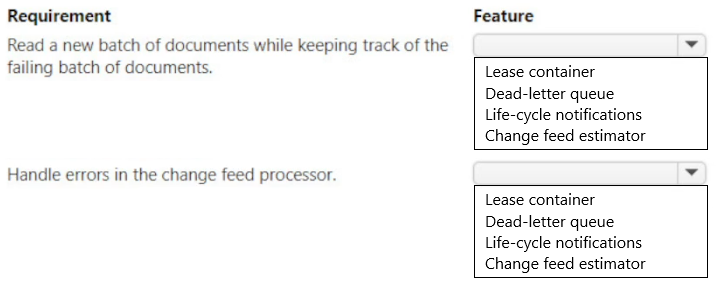
You implement an Azure solution to include Azure Cosmos DB, the latest Azure Cosmos DB SDK, and the Core (SQL) API. You also implement a change feed processor on a new container instance by using the Azure Functions trigger for Azure Cosmos DB.

A large batch of documents continues to fail when reading one of the documents in the batch. The same batch of documents is continuously retried by the triggered function and a new batch of documents must be read.

You need to implement the change feed processor to read the documents.

Which feature should you implement? To answer, select the appropriate features in the answer area.

NOTE: Each correct selection is worth one point.

Question 102

Question 103

Open question ↗

You are developing an application to store business-critical data in Azure Blob storage.

The application must meet the following requirements:

• Data must not be modified or deleted for a user-specified interval.

• Data must be protected from overwrites and deletes.

• Data must be written once and allowed to be read many times.

You need to protect the data in the Azure Blob storage account.

Which two actions should you perform? Each correct answer presents part of the solution.

NOTE: Each correct selection is worth one point.

  • A.Configure a time-based retention policy for the storage account.
  • B.Create an account shared-access signature (SAS).
  • C.Enable the blob change feed for the storage account.
  • D.Enable version-level immutability support for the storage account.
  • E.Enable point-in-time restore for containers in the storage account.
  • F.Create a service shared-access signature (SAS).

Question 104

Open question ↗

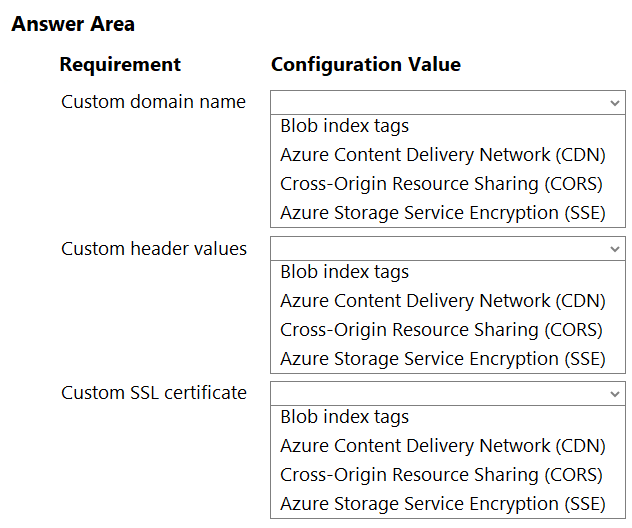
You are developing a static website hosted on Azure Blob Storage. You create a storage account and enable static website hosting.

The website must support the following requirements:

• Custom domain name

• Custom header values for all responses

• Custom SSL certificate

You need to implement the static website.

What should you configure? To answer, select the appropriate values in the answer area.

NOTE: Each correct selection is worth one point.

Question 104

Question 105

Open question ↗

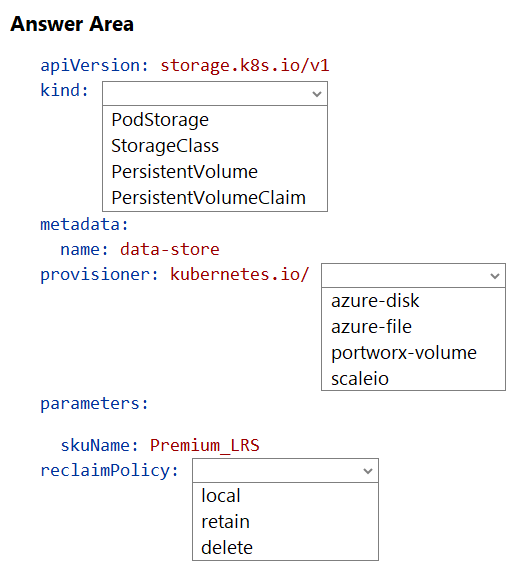
You are developing an application that runs in several customer Azure Kubernetes Service clusters. Within each cluster, a pod runs that collects performance data to be analyzed later. A large amount of data is collected so saving latency must be minimized.

The performance data must be stored so that pod restarts do not impact the stored data. Write latency should be minimized.

You need to configure blob storage.

How should you complete the YAML configuration? To answer, select the appropriate options in the answer area.

NOTE: Each correct selection is worth one point.
Question 105

Question 106

Open question ↗

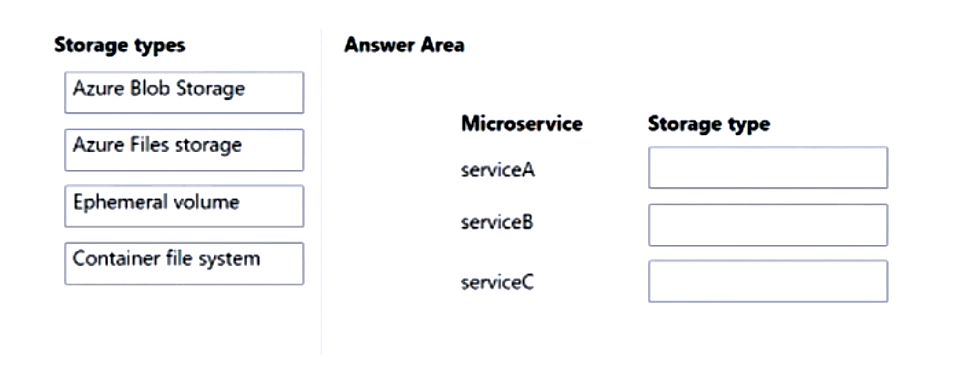
You are developing several microservices named serviceA, serviceB, and serviceC. You deploy the microservices to a new Azure Container Apps environment.

You have the following requirements:

• The microservices must persist data to storage.

• serviceA must persist data only visible to the current container and the storage must be restricted to the amount of disk space available in the container.

• serviceB must persist data for the lifetime of the replica and allow multiple containers in the replica to mount the same storage location.

• serviceC must persist data beyond the lifetime of the replica while allowing multiple containers to access the storage and enable per object permissions.

You need to configure storage for each microservice.

Which storage type should you use? To answer, drag the appropriate storage types to the correct microservices. Each storage type may be used once, more than once, or not at all. You may need to drag the split bar between panes or scroll to view content.

NOTE: Each correct selection is worth one point.

Question 106

Question 107

Open question ↗

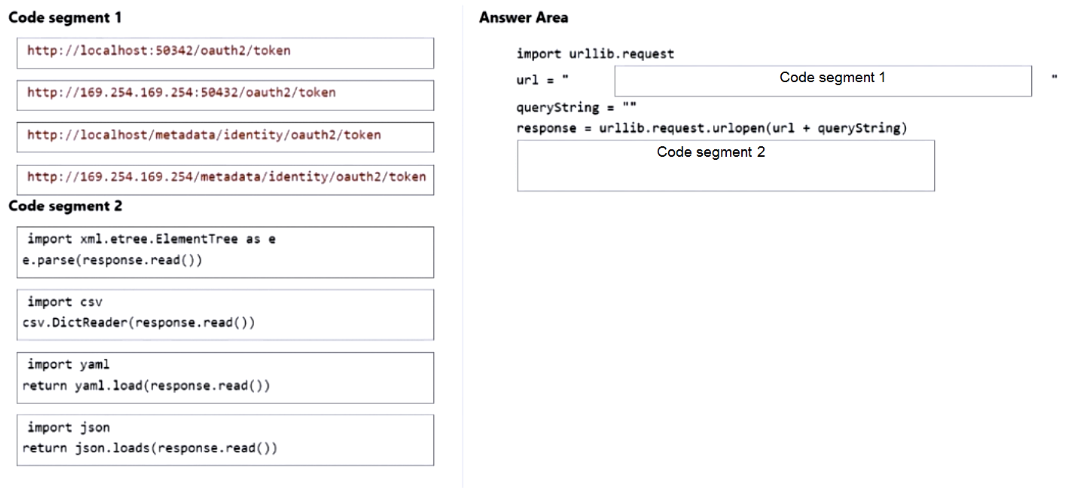
You are developing a web service that will run on Azure virtual machines that use Azure Storage. You configure all virtual machines to use managed identities.

You have the following requirements:

• Secret-based authentication mechanisms are not permitted for accessing an Azure Storage account.

• Must use only Azure Instance Metadata Service endpoints.

You need to write code to retrieve an access token to access Azure Storage. To answer, drag the appropriate code segments to the correct locations. Each code segment may be used once or not at all. You may need to drag the split bar between panes or scroll to view content.

NOTE: Each correct selection is worth one point.

Question 107

Question 108

Open question ↗

You are developing an app to store globally distributed data in several Azure Blob Storage containers. Each container hosts multiple blobs where each instance of the app will store the data. You enable versioning and soft delete for the blobs.

App testing and incorrect code have frequently corrupted data. Development of the app must allow data to be restored to a previous day for testing.

You need to configure the storage account to support point-in-time restore.

What should you do?

  • A.Enable the change feed on the storage account to begin capturing and recording changes.
  • B.Configure object replication and specify replication rules.
  • C.Create a snapshot of the blob in the hot tier.
  • D.Configure an immutability policy that is scoped to a blob version.

Question 109

Open question ↗

You are developing a Cosmos DB solution that will be deployed to multiple Azure regions.

Your solution must meet the following requirements:

• Read operations will never receive write operations that are out of order.

• Maximize concurrency of read operations in all regions.

You need to choose the consistency level for the solution.

Which consistency level should you use?

  • A.session
  • B.eventual
  • C.bounded staleness
  • D.consistent prefix

Question 110

Open question ↗

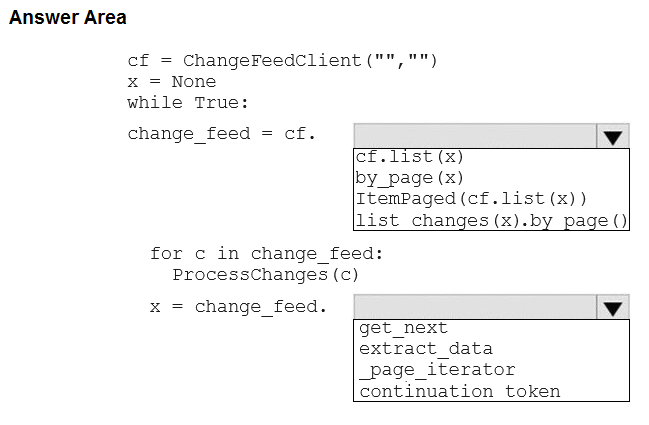
You are developing an application that monitors data added to an Azure Blob storage account.

You need to process each change made to the storage account.

How should you complete the code segment? To answer, select the appropriate options in the answer area.

NOTE: Each correct selection is worth one point.
Question 110