FEFreeExamDumps.in

AZ-204 Practice Questions — Page 14

Question 131

Open question ↗

Your company is developing an Azure API.

You need to implement authentication for the Azure API. You have the following requirements:

All API calls must be secure.

✑ Callers to the API must not send credentials to the API.

Which authentication mechanism should you use?

Question 131
  • A.Basic
  • B.Anonymous
  • C.Managed identity
  • D.Client certificate

Question 132

Open question ↗

You are a developer for a SaaS company that offers many web services.

All web services for the company must meet the following requirements:

✑ Use API Management to access the services

✑ Use OpenID Connect for authentication

✑ Prevent anonymous usage

A recent security audit found that several web services can be called without any authentication.

Which API Management policy should you implement?

  • A.jsonp
  • B.authentication-certificate
  • C.check-header
  • D.validate-jwt

Question 133

Open question ↗

Contoso, Ltd. provides an API to customers by using Azure API Management (APIM). The API authorizes users with a JWT token.

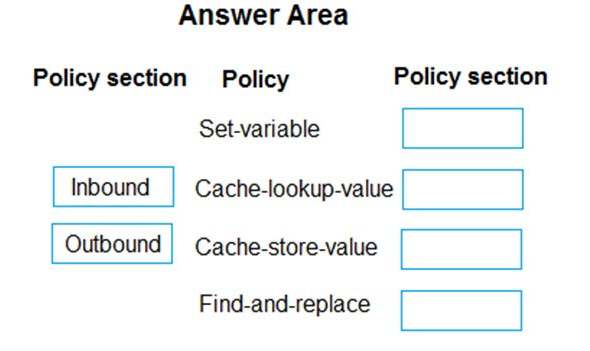
You must implement response caching for the APIM gateway. The caching mechanism must detect the user ID of the client that accesses data for a given location and cache the response for that user ID.

You need to add the following policies to the policies file:

✑ a set-variable policy to store the detected user identity

✑ a cache-lookup-value policy

✑ a cache-store-value policy

✑ a find-and-replace policy to update the response body with the user profile information

To which policy section should you add the policies? To answer, drag the appropriate sections to the correct policies. Each section may be used once, more than once, or not at all. You may need to drag the split bar between panes or scroll to view content.

NOTE: Each correct selection is worth one point.

Select and Place:

Question 133

Question 134

Open question ↗

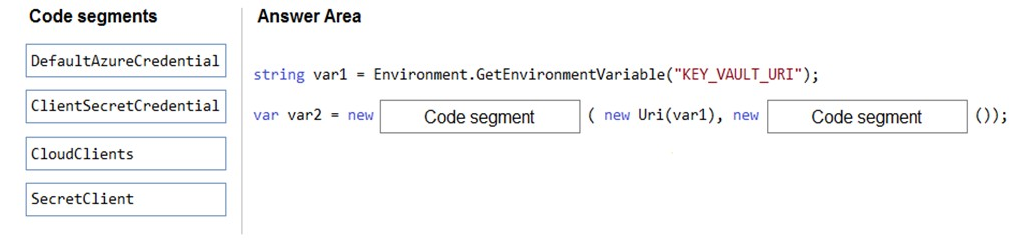
You are developing an Azure solution.

You need to develop code to access a secret stored in Azure Key Vault.

How should you complete the code segment? To answer, drag the appropriate code segments to the correct location. Each code segment may be used once, more than once, or not at all. You may need to drag the split bar between panes or scroll to view content.

NOTE: Each correct selection is worth one point.

Select and Place:

Question 134

Question 135

Open question ↗

You are developing an Azure App Service REST API.

The API must be called by an Azure App Service web app. The API must retrieve and update user profile information stored in Azure Active Directory (Azure AD).

You need to configure the API to make the updates.

Which two tools should you use? Each correct answer presents part of the solution.

NOTE: Each correct selection is worth one point.

  • A.Microsoft Graph API
  • B.Microsoft Authentication Library (MSAL)
  • C.Azure API Management
  • D.Microsoft Azure Security Center
  • E.Microsoft Azure Key Vault SDK

Question 136

Open question ↗

You develop a REST API. You implement a user delegation SAS token to communicate with Azure Blob storage.

The token is compromised.

You need to revoke the token.

What are two possible ways to achieve this goal? Each correct answer presents a complete solution.

NOTE: Each correct selection is worth one point.

  • A.Revoke the delegation key.
  • B.Delete the stored access policy.
  • C.Regenerate the account key.
  • D.Remove the role assignment for the security principle.

Question 137

Open question ↗

You develop and deploy an Azure Logic app that calls an Azure Function app. The Azure Function app includes an OpenAPI (Swagger) definition and uses an

Azure Blob storage account. All resources are secured by using Azure Active Directory (Azure AD).

The Azure Logic app must securely access the Azure Blob storage account. Azure AD resources must remain if the Azure Logic app is deleted.

You need to secure the Azure Logic app.

What should you do?

  • A.Create a user-assigned managed identity and assign role-based access controls.
  • B.Create an Azure AD custom role and assign the role to the Azure Blob storage account.
  • C.Create an Azure Key Vault and issue a client certificate.
  • D.Create a system-assigned managed identity and issue a client certificate.
  • E.Create an Azure AD custom role and assign role-based access controls.

Question 138

Open question ↗

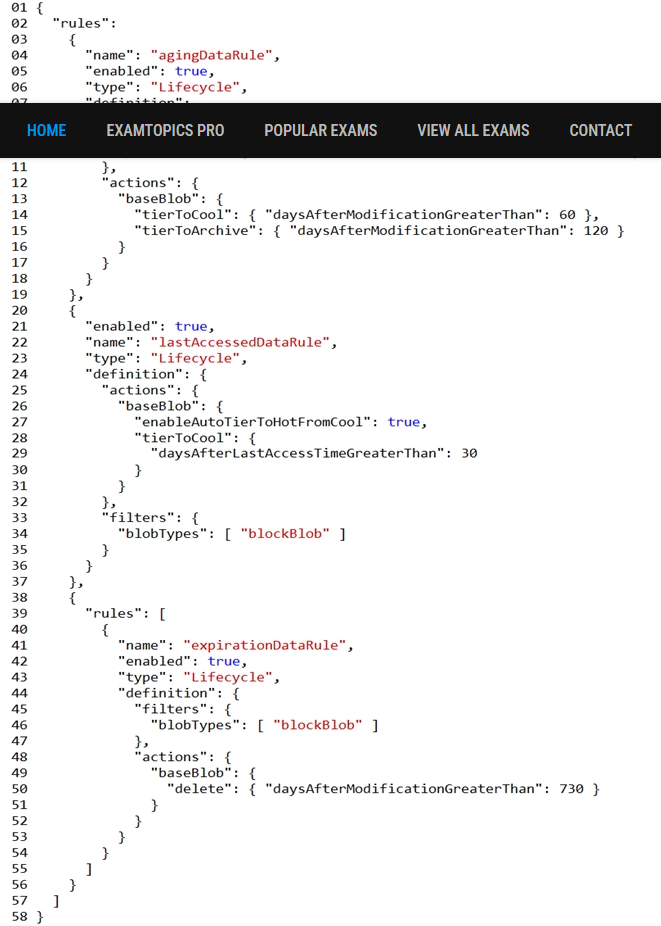
You are developing an application that uses a premium block blob storage account. You are optimizing costs by automating Azure Blob Storage access tiers.

You apply the following policy rules to the storage account. You must determine the implications of applying the rules to the data. (Line numbers are included for reference only.)

For each of the following statements, select Yes if the statement is true. Otherwise, select No.

NOTE: Each correct selection is worth one point.

Hot Area:

Question 138

Question 139

Open question ↗

You have an Azure Web app that uses Cosmos DB as a data store. You create a CosmosDB container by running the following PowerShell script:

$resourceGroupName = "testResourceGroup"

$accountName = "testCosmosAccount"

$databaseName = "testDatabase"

$containerName = "testContainer"

$partitionKeyPath = "/EmployeeId"

$autoscaleMaxThroughput = 5000

New-AzCosmosDBSqlContainer

-ResourceGroupName $resourceGroupName

-AccountName $accountName

-DatabaseName $databaseName

-Name $containerName

-PartitionKeyKind Hash

-PartitionKeyPath $partitionKeyPath

-AutoscaleMaxThroughput $autoscaleMaxThroughput

You create the following queries that target the container:

SELECT * FROM c WHERE c.EmployeeId > '12345'

SELECT * FROM c WHERE c.UserID = '12345'

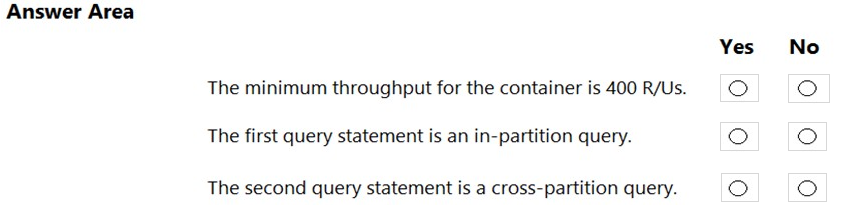
For each of the following statements, select Yes if the statement is true. Otherwise, select No.

NOTE: Each correct selection is worth one point.

Hot Area:
Question 139

Question 140

Open question ↗

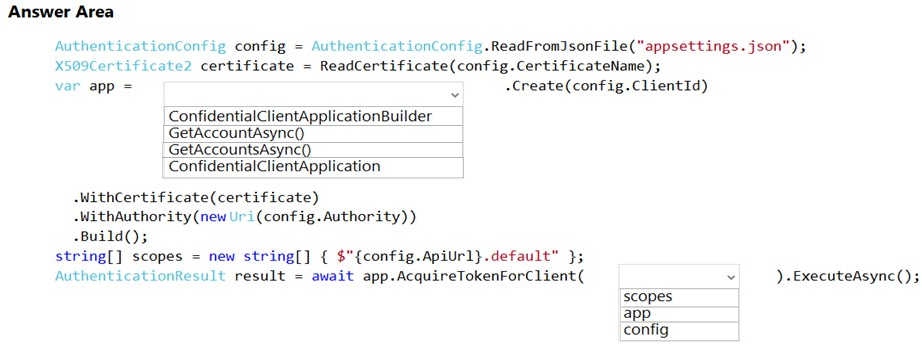
You are developing a web application that makes calls to the Microsoft Graph API. You register the application in the Azure portal and upload a valid X509 certificate.

You create an appsettings.json file containing the certificate name, client identifier for the application, and the tenant identifier of the Azure Active Directory (Azure

AD). You create a method named ReadCertificate to return the X509 certificate by name.

You need to implement code that acquires a token by using the certificate.

How should you complete the code segment? To answer, select the appropriate options in the answer area.

NOTE: Each correct selection is worth one point.

Hot Area:
Question 140