FEFreeExamDumps.in

AZ-204 Practice Questions — Page 18

Question 171

Open question ↗

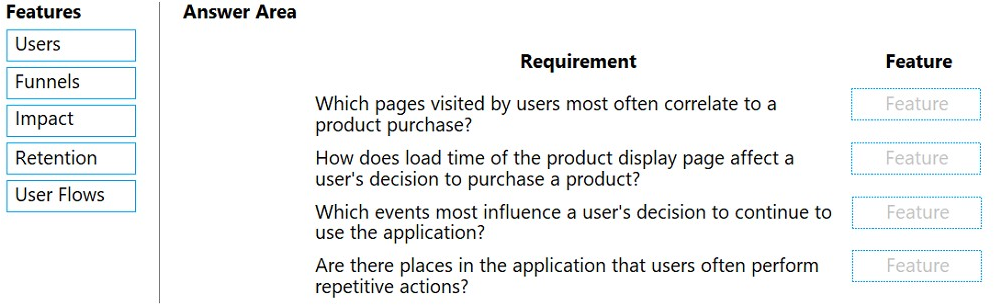
You develop an ASP.NET Core MVC application. You configure the application to track webpages and custom events.

You need to identify trends in application usage.

Which Azure Application Insights Usage Analysis features should you use? To answer, drag the appropriate features to the correct requirements. Each feature may be used once, more than once, or not at all. You may need to drag the split bar between panes or scroll to view content.

NOTE: Each correct selection is worth one point.

Select and Place:
Question 171

Question 172

Open question ↗

You develop a gateway solution for a public facing news API. The news API back end is implemented as a RESTful service and uses an OpenAPI specification.

You need to ensure that you can access the news API by using an Azure API Management service instance.

Which Azure PowerShell command should you run?

  • A.Import-AzureRmApiManagementApi -Context $ApiMgmtContext -SpecificationFormat "Swagger" -SpecificationPath $SwaggerPath -Path $Path
  • B.New-AzureRmApiManagementBackend -Context $ApiMgmtContext -Url $Url -Protocol http
  • C.New-AzureRmApiManagement -ResourceGroupName $ResourceGroup -Name $Name ג€"Location $Location -Organization $Org -AdminEmail $AdminEmail
  • D.New-AzureRmApiManagementBackendProxy -Url $ApiUrl

Question 173

Open question ↗

You are creating a hazard notification system that has a single signaling server which triggers audio and visual alarms to start and stop.

You implement Azure Service Bus to publish alarms. Each alarm controller uses Azure Service Bus to receive alarm signals as part of a transaction. Alarm events must be recorded for audit purposes. Each transaction record must include information about the alarm type that was activated.

You need to implement a reply trail auditing solution.

Which two actions should you perform? Each correct answer presents part of the solution.

NOTE: Each correct selection is worth one point.

  • A.Assign the value of the hazard message SessionID property to the ReplyToSessionId property.
  • B.Assign the value of the hazard message MessageId property to the DevileryCount property.
  • C.Assign the value of the hazard message SessionID property to the SequenceNumber property.
  • D.Assign the value of the hazard message MessageId property to the CorrelationId property.
  • E.Assign the value of the hazard message SequenceNumber property to the DeliveryCount property.
  • F.Assign the value of the hazard message MessageId property to the SequenceNumber property.

Question 174

Open question ↗

You are developing an Azure function that connects to an Azure SQL Database instance. The function is triggered by an Azure Storage queue.

You receive reports of numerous System.InvalidOperationExceptions with the following message:

`Timeout expired. The timeout period elapsed prior to obtaining a connection from the pool. This may have occurred because all pooled connections were in use and max pool size was reached.`

You need to prevent the exception.

What should you do?

  • A.In the host.json file, decrease the value of the batchSize option
  • B.Convert the trigger to Azure Event Hub
  • C.Convert the Azure Function to the Premium plan
  • D.In the function.json file, change the value of the type option to queueScaling

Question 175

Open question ↗

Note: This question is part of a series of questions that present the same scenario. Each question in the series contains a unique solution. Determine whether the solution meets the stated goals.

You are developing and deploying several ASP.NET web applications to Azure App Service. You plan to save session state information and HTML output.

You must use a storage mechanism with the following requirements:

✑ Share session state across all ASP.NET web applications.

✑ Support controlled, concurrent access to the same session state data for multiple readers and a single writer.

✑ Save full HTTP responses for concurrent requests.

You need to store the information.

Proposed Solution: Deploy and configure Azure Cache for Redis. Update the web applications.

Does the solution meet the goal?

  • A.Yes
  • B.No

Question 176

Open question ↗

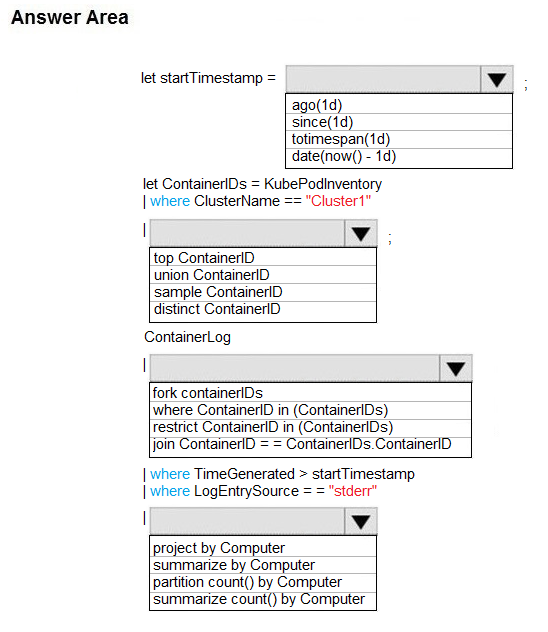
You are debugging an application that is running on Azure Kubernetes cluster named cluster1. The cluster uses Azure Monitor for containers to monitor the cluster.

The application has sticky sessions enabled on the ingress controller.

Some customers report a large number of errors in the application over the last 24 hours.

You need to determine on which virtual machines (VMs) the errors are occurring.

How should you complete the Azure Monitor query? To answer, select the appropriate options in the answer area.

NOTE: Each correct selection is worth one point.

Hot Area:

Question 176

Question 177

Open question ↗

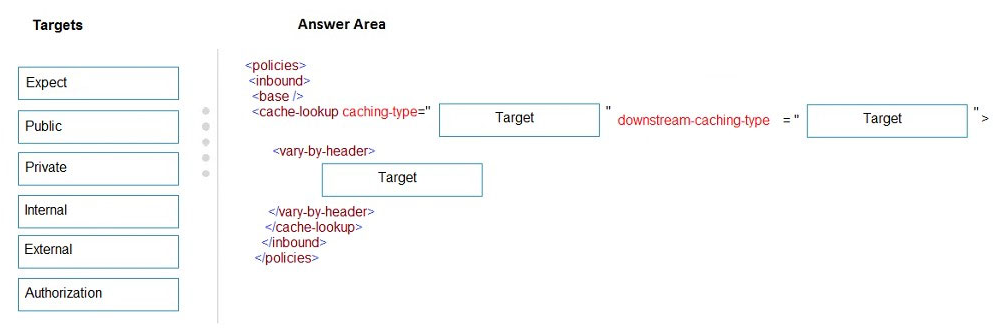
A web service provides customer summary information for e-commerce partners. The web service is implemented as an Azure Function app with an HTTP trigger.

Access to the API is provided by an Azure API Management instance. The API Management instance is configured in consumption plan mode. All API calls are authenticated by using OAuth.

API calls must be cached. Customers must not be able to view cached data for other customers.

You need to configure API Management policies for caching.

How should you complete the policy statement?

Select and Place:

Question 177

Question 178

Open question ↗

You are developing applications for a company. You plan to host the applications on Azure App Services.

The company has the following requirements:

✑ Every five minutes verify that the websites are responsive.

✑ Verify that the websites respond within a specified time threshold. Dependent requests such as images and JavaScript files must load properly.

✑ Generate alerts if a website is experiencing issues.

✑ If a website fails to load, the system must attempt to reload the site three more times.

You need to implement this process with the least amount of effort.

What should you do?

  • A.Create a Selenium web test and configure it to run from your workstation as a scheduled task.
  • B.Set up a URL ping test to query the home page.
  • C.Create an Azure function to query the home page.
  • D.Create a multi-step web test to query the home page.
  • E.Create a Custom Track Availability Test to query the home page.

Question 179

Open question ↗

You develop and add several functions to an Azure Function app that uses the latest runtime host. The functions contain several REST API endpoints secured by using SSL. The Azure Function app runs in a Consumption plan.

You must send an alert when any of the function endpoints are unavailable or responding too slowly.

You need to monitor the availability and responsiveness of the functions.

What should you do?

  • A.Create a URL ping test.
  • B.Create a timer triggered function that calls TrackAvailability() and send the results to Application Insights.
  • C.Create a timer triggered function that calls GetMetric("Request Size") and send the results to Application Insights.
  • D.Add a new diagnostic setting to the Azure Function app. Enable the FunctionAppLogs and Send to Log Analytics options.

Question 180

Open question ↗

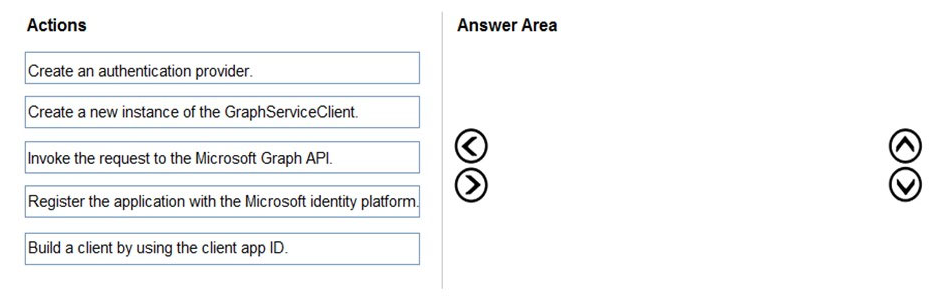
You are developing an application to retrieve user profile information. The application will use the Microsoft Graph SDK.

The app must retrieve user profile information by using a Microsoft Graph API call.

You need to call the Microsoft Graph API from the application.

In which order should you perform the actions? To answer, move all actions from the list of actions to the answer area and arrange them in the correct order.

Select and Place:

Question 180