FEFreeExamDumps.in

AZ-204 Practice Questions — Page 23

Question 221

Open question ↗

Note: This question is part of a series of questions that present the same scenario. Each question in the series contains a unique solution that might meet the stated goals. Some question sets might have more than one correct solution, while others might not have a correct solution.

After you answer a question in this section, you will NOT be able to return to it. As a result, these questions will not appear in the review screen.

You are developing an Azure Service application that processes queue data when it receives a message from a mobile application. Messages may not be sent to the service consistently.

You have the following requirements:

✑ Queue size must not grow larger than 80 gigabytes (GB).

✑ Use first-in-first-out (FIFO) ordering of messages.

✑ Minimize Azure costs.

You need to implement the messaging solution.

Solution: Use the .Net API to add a message to an Azure Service Bus Queue from the mobile application. Create an Azure Function App that uses an Azure

Service Bus Queue trigger.

Does the solution meet the goal?

  • A.Yes
  • B.No

Question 222

Open question ↗

You are building a loyalty program for a major snack producer. When customers buy a snack at any of 100 participating retailers the event is recorded in Azure

Event Hub. Each retailer is given a unique identifier that is used as the primary identifier for the loyalty program.

Retailers must be able to be added or removed at any time. Retailers must only be able to record sales for themselves.

You need to ensure that retailers can record sales.

What should you do?

  • A.Use publisher policies for retailers.
  • B.Create a partition for each retailer.
  • C.Define a namespace for each retailer.

Question 223

Open question ↗

You develop a solution that uses Azure Virtual Machines (VMs).

The VMs contain code that must access resources in an Azure resource group. You grant the VM access to the resource group in Resource Manager.

You need to obtain an access token that uses the VM's system-assigned managed identity.

Which two actions should you perform? Each correct answer presents part of the solution.

  • A.From the code on the VM, call Azure Resource Manager using an access token.
  • B.Use PowerShell on a remote machine to make a request to the local managed identity for Azure resources endpoint.
  • C.Use PowerShell on the VM to make a request to the local managed identity for Azure resources endpoint.
  • D.From the code on the VM, call Azure Resource Manager using a SAS token.
  • E.From the code on the VM, generate a user delegation SAS token.

Question 224

Open question ↗

You are building a B2B web application that uses Azure B2B collaboration for authentication. Paying customers authenticate to Azure B2B using federation.

The application allows users to sign up for trial accounts using any email address.

When a user converts to a paying customer, the data associated with the trial should be kept, but the user must authenticate using federation.

You need to update the user in Azure Active Directory (Azure AD) when they convert to a paying customer.

Which Graph API parameter is used to change authentication from one-time passcodes to federation?

  • A.resetRedemption
  • B.Status
  • C.userFlowType
  • D.invitedUser

Question 225

Open question ↗

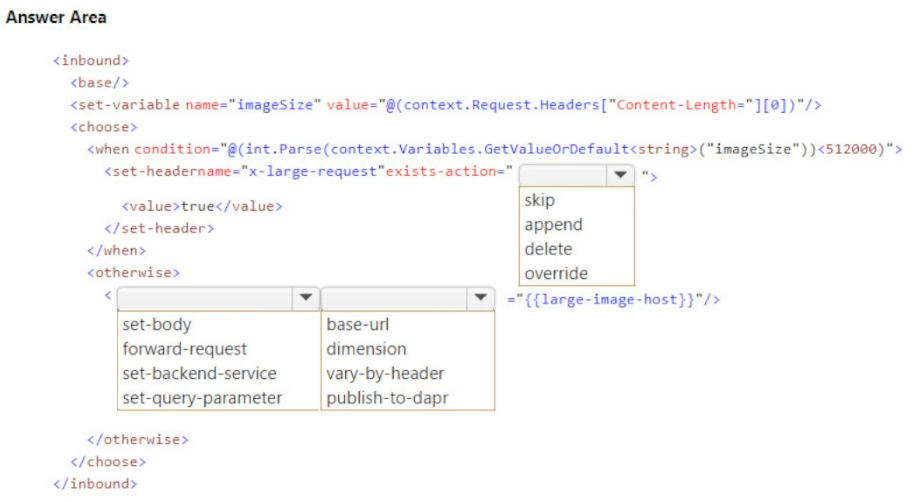
You develop an image upload service that is exposed using Azure API Management. Images are analyzed after upload for automatic tagging.

Images over 500 KB are processed by a different backend that offers a lower tier of service that costs less money. The lower tier of service is denoted by a header named x-large-request. Images over 500 KB must never be processed by backends for smaller images and must always be charged the lower price.

You need to implement API Management policies to ensure that images are processed correctly.

How should you complete the API Management inbound policy? To answer, select the appropriate options in the answer area.

NOTE: Each correct selection is worth one point.

Question 225

Question 226

Open question ↗

You develop and deploy several APIs to Azure API Management.

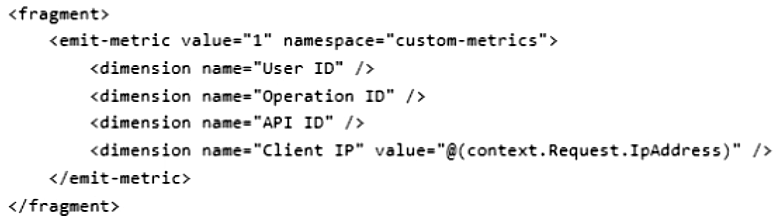
You create the following policy fragment named APICounts:

The policy fragment must be reused across various scopes and APIs. The policy fragment must be applied to all APIs and run when a calling system invokes any API.

You need to implement the policy fragment.

Question 226

Question 227

Open question ↗

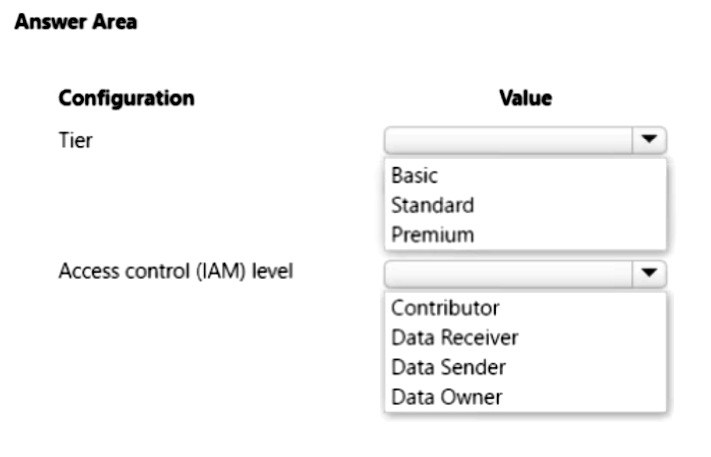
You are developing a solution that uses several Azure Service Bus queues. You create an Azure Event Grid subscription for the Azure Service Bus namespace. You use Azure Functions as subscribers to process the messages.

You need to emit events to Azure Event Grid from the queues. You must use the principal of least privilege and minimize costs.

Which Azure Service Bus values should you use? To answer, select the appropriate options in the answer area.

NOTE: Each correct selection is worth one point.

Question 227

Question 228

Open question ↗

A company is developing a solution that allows smart refrigerators to send temperature information to a central location.

The solution must receive and store messages until they can be processed. You create an Azure Service Bus instance by providing a name, pricing tier, subscription, resource group, and location.

You need to complete the configuration.

Which Azure CLI or PowerShell command should you run?

  • A.![image](https://img.examtopics.com/az-204/image467.png)
  • B.![image](https://img.examtopics.com/az-204/image468.png)
  • C.![image](https://img.examtopics.com/az-204/image469.png)
  • D.![image](https://img.examtopics.com/az-204/image470.png)

Question 229

Open question ↗

You are developing several Azure API Management (APIM) hosted APIs.

You must make several minor and non-breaking changes to one of the APIs. The API changes include the following requirements:

• Must not disrupt callers of the API.

• Enable roll back if you find issues.

• Documented to enable developers to understand what is new.

• Tested before publishing.

You need to update the API.

What should you do?

  • A.Configure and apply header-based versioning.
  • B.Create and publish a product.
  • C.Configure and apply a custom policy.
  • D.Add a new revision to the API.
  • E.Configure and apply query string-based versioning.

Question 230

Open question ↗

You are developing several microservices to run on Azure Container Apps for a company. External TCP ingress traffic from the internet has been enabled for the microservices.

The company requires that the microservices must scale based on an Azure Event Hub trigger.

You need to scale the microservices by using a custom scaling rule.

Which two Kubernetes Event-driven Autoscaling (KEDA) trigger fields should you use? Each correct answer presents part of the solution.

NOTE: Each correct selection is worth one point.

  • A.metadata
  • B.type
  • C.authenticationRef
  • D.name
  • E.metricType