FEFreeExamDumps.in

DP-203 Practice Questions — Page 10

You are developing a solution that will stream to Azure Stream Analytics. The solution will have both streaming data and reference data.

Which input type should you use for the reference data?

  • A.Azure Service Bus
  • B.Azure Blob storage
  • C.Azure IoT Hub
  • D.Azure Event Hubs

You have an Azure subscription that contains an Azure Synapse Analytics workspace and a user named User1.

You need to ensure that User1 can create a new lake database by using an Azure Synapse database template from Gallery. The solution must follow the principle of least privilege.

Which role should you assign to User1?

  • A.Synapse Contributor ✓
  • B.Synapse Administrator
  • C.Synapse User
  • D.Storage Blob Data Contributor

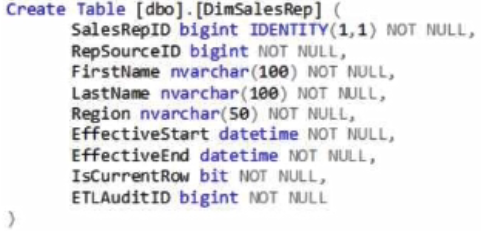
You are designing the dimensions for a data warehouse in an Azure Synapse Analytics dedicated SQL pool.

You build a table by using the statement shown in the following exhibit.

Use the drop-down menus to select the answer choice that completes each statement based on the information presented in the exhibit.

NOTE: Each correct selection is worth one point.

Question 93

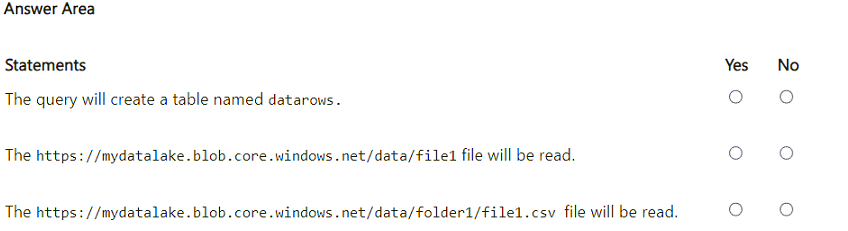
You have an Azure subscription that contains an Azure Synapse Analytics serverless SQL pool.

You run the following query in the pool.

SELECT *

FROM OPENROWSET(BULK 'https://mydatalake.blob.core.windows.net/data/**',

FORMAT = 'CSV') AS datarows;

For each of the following statements, select Yes if the statement is true. Otherwise, select No.

NOTE: Each correct selection is worth one point.

Question 94

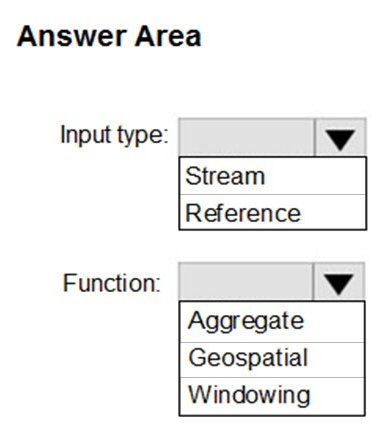
You plan to create a real-time monitoring app that alerts users when a device travels more than 200 meters away from a designated location.

You need to design an Azure Stream Analytics job to process the data for the planned app. The solution must minimize the amount of code developed and the number of technologies used.

What should you include in the Stream Analytics job? To answer, select the appropriate options in the answer area.

NOTE: Each correct selection is worth one point.

Hot Area:

Question 95

A company has a real-time data analysis solution that is hosted on Microsoft Azure. The solution uses Azure Event Hub to ingest data and an Azure Stream

Analytics cloud job to analyze the data. The cloud job is configured to use 120 Streaming Units (SU).

You need to optimize performance for the Azure Stream Analytics job.

Which two actions should you perform? Each correct answer presents part of the solution.

NOTE: Each correct selection is worth one point.

  • A.Implement event ordering.
  • B.Implement Azure Stream Analytics user-defined functions (UDF).
  • C.Implement query parallelization by partitioning the data output.
  • D.Scale the SU count for the job up.
  • E.Scale the SU count for the job down.
  • F.Implement query parallelization by partitioning the data input.

You need to trigger an Azure Data Factory pipeline when a file arrives in an Azure Data Lake Storage Gen2 container.

Which resource provider should you enable?

  • A.Microsoft.Sql
  • B.Microsoft.Automation
  • C.Microsoft.EventGrid
  • D.Microsoft.EventHub

You plan to perform batch processing in Azure Databricks once daily.

Which type of Databricks cluster should you use?

  • A.High Concurrency
  • B.automated
  • C.interactive

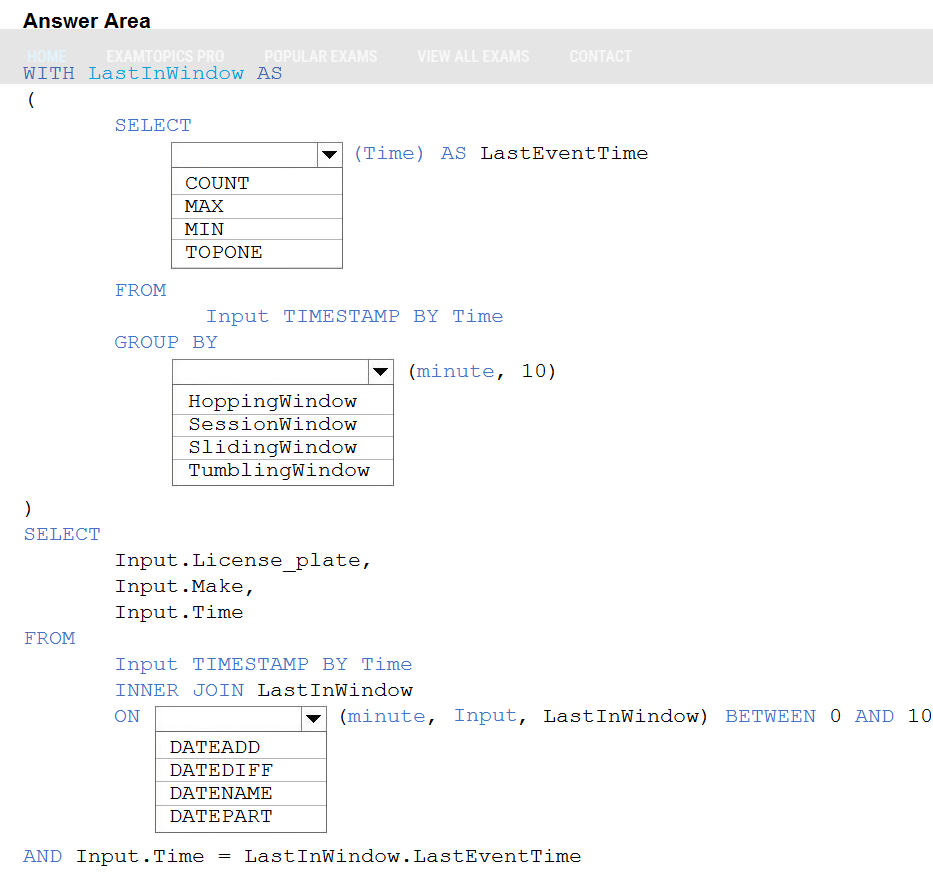
You are processing streaming data from vehicles that pass through a toll booth.

You need to use Azure Stream Analytics to return the license plate, vehicle make, and hour the last vehicle passed during each 10-minute window.

How should you complete the query? To answer, select the appropriate options in the answer area.

NOTE: Each correct selection is worth one point.

Hot Area:

Question 99

Question 100

Open question ↗

You have an Azure Data Factory instance that contains two pipelines named Pipeline1 and Pipeline2.

Pipeline1 has the activities shown in the following exhibit.

Pipeline2 has the activities shown in the following exhibit.

You execute Pipeline2, and Stored procedure1 in Pipeline1 fails.

What is the status of the pipeline runs?

Question 100
  • A.Pipeline1 and Pipeline2 succeeded.
  • B.Pipeline1 and Pipeline2 failed.
  • C.Pipeline1 succeeded and Pipeline2 failed.
  • D.Pipeline1 failed and Pipeline2 succeeded.