FEFreeExamDumps.in

DP-203 Practice Questions — Page 17

Question 161

Open question ↗

You are designing an Azure Synapse Analytics workspace.

You need to recommend a solution to provide double encryption of all the data at rest.

Which two components should you include in the recommendation? Each correct answer presents part of the solution.

NOTE: Each correct selection is worth one point.

  • A.an X.509 certificate
  • B.an RSA key
  • C.an Azure virtual network that has a network security group (NSG)
  • D.an Azure Policy initiative
  • E.an Azure key vault that has purge protection enabled

Question 162

Open question ↗

You have an Azure Synapse Analytics serverless SQL pool named Pool1 and an Azure Data Lake Storage Gen2 account named storage1. The

AllowBlobPublicAccess property is disabled for storage1.

You need to create an external data source that can be used by Azure Active Directory (Azure AD) users to access storage from Pool1.

What should you create first?

  • A.an external resource pool
  • B.an external library
  • C.database scoped credentials
  • D.a remote service binding

Question 163

Open question ↗

You have an Azure Data Factory pipeline named Pipeline1. Pipeline1 contains a copy activity that sends data to an Azure Data Lake Storage Gen2 account.

Pipeline1 is executed by a schedule trigger.

You change the copy activity sink to a new storage account and merge the changes into the collaboration branch.

After Pipeline1 executes, you discover that data is NOT copied to the new storage account.

You need to ensure that the data is copied to the new storage account.

What should you do?

  • A.Publish from the collaboration branch.
  • B.Create a pull request.
  • C.Modify the schedule trigger.
  • D.Configure the change feed of the new storage account.

Question 164

Open question ↗

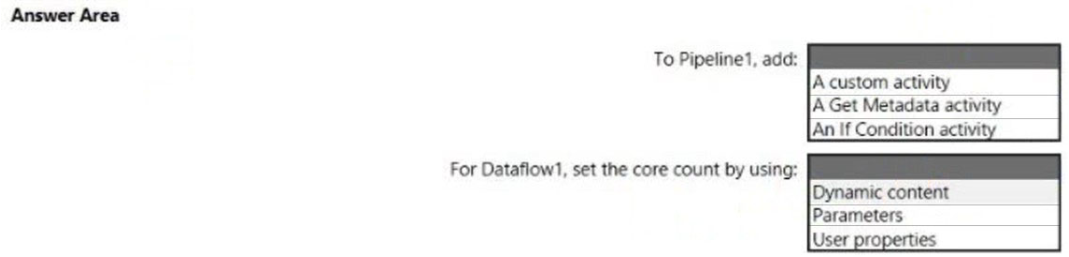
You have an Azure Synapse Analytics pipeline named Pipeline1 that contains a data flow activity named Dataflow1.

Pipeline1 retrieves files from an Azure Data Lake Storage Gen 2 account named storage1.

Dataflow1 uses the AutoResolveIntegrationRuntime integration runtime configured with a core count of 128.

You need to optimize the number of cores used by Dataflow1 to accommodate the size of the files in storage1.

What should you configure? To answer, select the appropriate options in the answer area.

Hot Area:

Question 164

Question 165

Open question ↗

Note: This question is part of a series of questions that present the same scenario. Each question in the series contains a unique solution that might meet the stated goals. Some question sets might have more than one correct solution, while others might not have a correct solution.

After you answer a question in this section, you will NOT be able to return to it. As a result, these questions will not appear in the review screen.

You plan to create an Azure Databricks workspace that has a tiered structure. The workspace will contain the following three workloads:

✑ A workload for data engineers who will use Python and SQL.

✑ A workload for jobs that will run notebooks that use Python, Scala, and SQL.

✑ A workload that data scientists will use to perform ad hoc analysis in Scala and R.

The enterprise architecture team at your company identifies the following standards for Databricks environments:

✑ The data engineers must share a cluster.

✑ The job cluster will be managed by using a request process whereby data scientists and data engineers provide packaged notebooks for deployment to the cluster.

✑ All the data scientists must be assigned their own cluster that terminates automatically after 120 minutes of inactivity. Currently, there are three data scientists.

You need to create the Databricks clusters for the workloads.

Solution: You create a Standard cluster for each data scientist, a High Concurrency cluster for the data engineers, and a Standard cluster for the jobs.

Does this meet the goal?

  • A.Yes
  • B.No

Question 166

Open question ↗

Note: This question is part of a series of questions that present the same scenario. Each question in the series contains a unique solution that might meet the stated goals. Some question sets might have more than one correct solution, while others might not have a correct solution.

After you answer a question in this section, you will NOT be able to return to it. As a result, these questions will not appear in the review screen.

You plan to create an Azure Databricks workspace that has a tiered structure. The workspace will contain the following three workloads:

✑ A workload for data engineers who will use Python and SQL.

✑ A workload for jobs that will run notebooks that use Python, Scala, and SQL.

✑ A workload that data scientists will use to perform ad hoc analysis in Scala and R.

The enterprise architecture team at your company identifies the following standards for Databricks environments:

✑ The data engineers must share a cluster.

✑ The job cluster will be managed by using a request process whereby data scientists and data engineers provide packaged notebooks for deployment to the cluster.

✑ All the data scientists must be assigned their own cluster that terminates automatically after 120 minutes of inactivity. Currently, there are three data scientists.

You need to create the Databricks clusters for the workloads.

Solution: You create a Standard cluster for each data scientist, a High Concurrency cluster for the data engineers, and a High Concurrency cluster for the jobs.

Does this meet the goal?
  • A.Yes
  • B.No

Question 167

Open question ↗

You are designing a folder structure for the files in an Azure Data Lake Storage Gen2 account. The account has one container that contains three years of data.

You need to recommend a folder structure that meets the following requirements:

✑ Supports partition elimination for queries by Azure Synapse Analytics serverless SQL pools

✑ Supports fast data retrieval for data from the current month

✑ Simplifies data security management by department

Which folder structure should you recommend?

  • A.\Department\DataSource\YYYY\MM\DataFile_YYYYMMDD.parquet
  • B.\DataSource\Department\YYYYMM\DataFile_YYYYMMDD.parquet
  • C.\DD\MM\YYYY\Department\DataSource\DataFile_DDMMYY.parquet
  • D.\YYYY\MM\DD\Department\DataSource\DataFile_YYYYMMDD.parquet

Question 168

Open question ↗

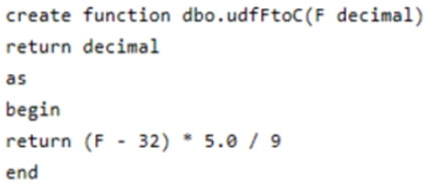
You have an Azure subscription that contains an Azure Synapse Analytics dedicated SQL pool named Pool1. Pool1 receives new data once every 24 hours.

You have the following function.

You have the following query.

The query is executed once every 15 minutes and the @parameter value is set to the current date.

You need to minimize the time it takes for the query to return results.

Which two actions should you perform? Each correct answer presents part of the solution.

NOTE: Each correct selection is worth one point.

Question 168
  • A.Create an index on the avg_f column.
  • B.Convert the avg_c column into a calculated column.
  • C.Create an index on the sensorid column.
  • D.Enable result set caching.
  • E.Change the table distribution to replicate.

Question 169

Open question ↗

You need to design a solution that will process streaming data from an Azure Event Hub and output the data to Azure Data Lake Storage. The solution must ensure that analysts can interactively query the streaming data.

What should you use?

  • A.Azure Stream Analytics and Azure Synapse notebooks
  • B.Structured Streaming in Azure Databricks
  • C.event triggers in Azure Data Factory
  • D.Azure Queue storage and read-access geo-redundant storage (RA-GRS)

Question 170

Open question ↗

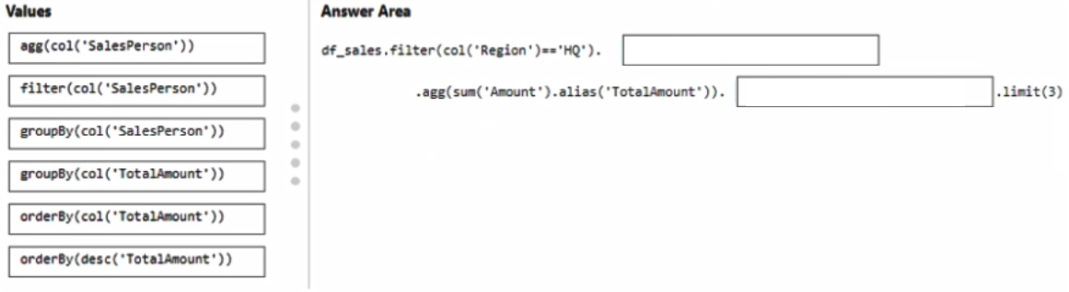
You have an Azure subscription that contains an Azure Databricks workspace. The workspace contains a notebook named Notebook1.

In Notebook1, you create an Apache Spark DataFrame named df_sales that contains the following columns:

• Customer

• SalesPerson

• Region

• Amount

You need to identify the three top performing salespersons by amount for a region named HQ.

How should you complete the query? To answer, drag the appropriate values to the correct targets. Each value may be used once, more than once, or not at all. You may need to drag the split bar between panes or scroll to view content.

NOTE: Each correct selection is worth one point.

Question 170