FEFreeExamDumps.in

DP-203 Practice Questions — Page 25

Question 241

Open question ↗

You are monitoring an Azure Stream Analytics job.

The Backlogged Input Events count has been 20 for the last hour.

You need to reduce the Backlogged Input Events count.

What should you do?

  • A.Drop late arriving events from the job.
  • B.Add an Azure Storage account to the job.
  • C.Increase the streaming units for the job.
  • D.Stop the job.

Question 242

Open question ↗

You are designing an Azure Databricks interactive cluster. The cluster will be used infrequently and will be configured for auto-termination.

You need to ensure that the cluster configuration is retained indefinitely after the cluster is terminated. The solution must minimize costs.

What should you do?

  • A.Pin the cluster.
  • B.Create an Azure runbook that starts the cluster every 90 days.
  • C.Terminate the cluster manually when processing completes.
  • D.Clone the cluster after it is terminated.

Question 243

Open question ↗

You have an Azure data solution that contains an enterprise data warehouse in Azure Synapse Analytics named DW1.

Several users execute ad hoc queries to DW1 concurrently.

You regularly perform automated data loads to DW1.

You need to ensure that the automated data loads have enough memory available to complete quickly and successfully when the adhoc queries run.

What should you do?

  • A.Hash distribute the large fact tables in DW1 before performing the automated data loads.
  • B.Assign a smaller resource class to the automated data load queries.
  • C.Assign a larger resource class to the automated data load queries.
  • D.Create sampled statistics for every column in each table of DW1.

Question 244

Open question ↗

You have an Azure Synapse Analytics dedicated SQL pool named Pool1 and a database named DB1. DB1 contains a fact table named Table1.

You need to identify the extent of the data skew in Table1.

What should you do in Synapse Studio?

  • A.Connect to the built-in pool and run DBCC PDW_SHOWSPACEUSED.
  • B.Connect to the built-in pool and run DBCC CHECKALLOC.
  • C.Connect to Pool1 and query sys.dm_pdw_node_status.
  • D.Connect to Pool1 and query sys.dm_pdw_nodes_db_partition_stats.

Question 245

Open question ↗

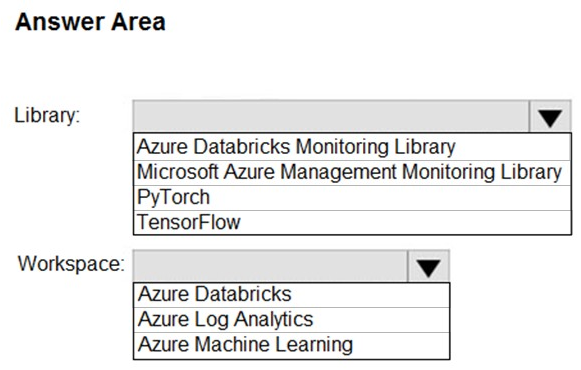
You need to collect application metrics, streaming query events, and application log messages for an Azure Databrick cluster.

Which type of library and workspace should you implement? To answer, select the appropriate options in the answer area.

NOTE: Each correct selection is worth one point.

Hot Area:

Question 245

Question 246

Open question ↗

You have a SQL pool in Azure Synapse.

You discover that some queries fail or take a long time to complete.

You need to monitor for transactions that have rolled back.

Which dynamic management view should you query?

  • A.sys.dm_pdw_request_steps
  • B.sys.dm_pdw_nodes_tran_database_transactions
  • C.sys.dm_pdw_waits
  • D.sys.dm_pdw_exec_sessions

Question 247

Open question ↗

You are monitoring an Azure Stream Analytics job.

You discover that the Backlogged Input Events metric is increasing slowly and is consistently non-zero.

You need to ensure that the job can handle all the events.

What should you do?

  • A.Change the compatibility level of the Stream Analytics job.
  • B.Increase the number of streaming units (SUs).
  • C.Remove any named consumer groups from the connection and use $default.
  • D.Create an additional output stream for the existing input stream.

Question 248

Open question ↗

You are designing an inventory updates table in an Azure Synapse Analytics dedicated SQL pool. The table will have a clustered columnstore index and will include the following columns:

You identify the following usage patterns:

✑ Analysts will most commonly analyze transactions for a warehouse.

✑ Queries will summarize by product category type, date, and/or inventory event type.

You need to recommend a partition strategy for the table to minimize query times.

On which column should you partition the table?

Question 248
  • A.EventTypeID
  • B.ProductCategoryTypeID
  • C.EventDate
  • D.WarehouseID

Question 249

Open question ↗

You are designing a star schema for a dataset that contains records of online orders. Each record includes an order date, an order due date, and an order ship date.

You need to ensure that the design provides the fastest query times of the records when querying for arbitrary date ranges and aggregating by fiscal calendar attributes.

Which two actions should you perform? Each correct answer presents part of the solution.

NOTE: Each correct selection is worth one point.

  • A.Create a date dimension table that has a DateTime key.
  • B.Use built-in SQL functions to extract date attributes.
  • C.Create a date dimension table that has an integer key in the format of YYYYMMDD.
  • D.In the fact table, use integer columns for the date fields.
  • E.Use DateTime columns for the date fields.

Question 250

Open question ↗

You manage an enterprise data warehouse in Azure Synapse Analytics.

Users report slow performance when they run commonly used queries. Users do not report performance changes for infrequently used queries.

You need to monitor resource utilization to determine the source of the performance issues.

Which metric should you monitor?

  • A.DWU percentage
  • B.Cache hit percentage
  • C.DWU limit
  • D.Data IO percentage