FEFreeExamDumps.in

DP-300 Practice Questions — Page 25

Question 241

Open question ↗

You plan to deploy two instances of SQL Server on Azure virtual machines in a highly available configuration that will use an Always On availability group.

You need to recommend a deployment solution that meets the following requirements:

• Provides a Service Level Agreement (SLA) of at least 99.95%

• Replicates databases in the same group synchronously

• Minimizes the latency of database writes

What should you recommend?

  • A.Create two proximity groups and two availability sets. Deploy each virtual machine to a unique availability set. Add one virtual machine to each proximity group.
  • B.Create a proximity group and an availability set. Deploy each virtual machine to the availability set. Add both virtual machines to the proximity group.
  • C.Create a proximity group and two availability sets. Deploy each virtual machine to a unique availability set. Add both virtual machines to the proximity group.
  • D.Create two proximity groups and a single availability set. Deploy both virtual machines to the availability set. Add one virtual machine to each proximity group.
Question 242

Open question ↗

You have a single availability set that contains two SQL Server on Azure Virtual Machines instances.

The instances were deployed by using an Azure Marketplace SQL Server 2019 Enterprise image that has the latest cumulative updates applied. The instances are configured as the nodes of a failover cluster instance (FCI) named FCI1.

You need to ensure that client applications can connect to FCI1. The solution must meet the following requirements:

• Provide an availability SLA.

• Minimize costs.

What should you create?

  • A.an Azure Standard Load Balancer
  • B.a virtual network name (VNN) resource
  • C.a Basic Azure Load Balancer
  • D.a distributed network name (DNN) resource

Question 243

Open question ↗

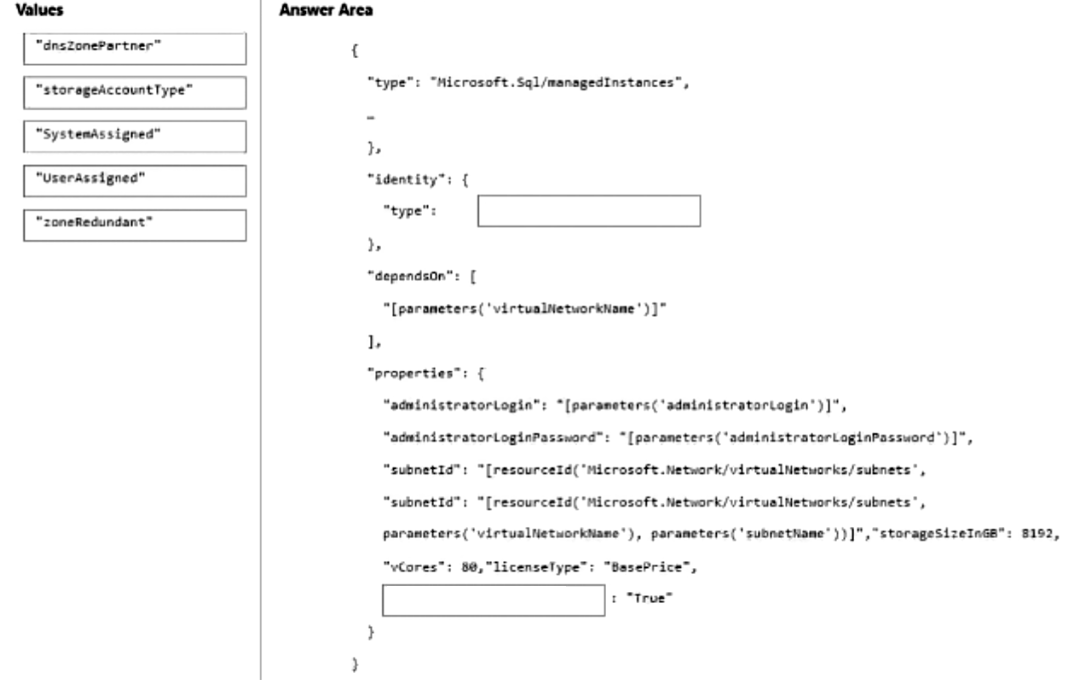
You have an Azure subscription.

You need to deploy an Azure SQL managed instance by using an Azure Resource Manager (ARM) template. The solution must meet the following requirements:

• The SQL managed instance must be assigned a unique identity.

• The SQL managed instance must be available in the event of an Azure datacenter outage.

How should you complete the template? To answer, drag the appropriate values to the correct targets. Each value may be used once, more than once, or not at all. You may need to drag the split bar between panes or scroll to view content.

NOTE: Each correct selection is worth one point.

Question 243

Question 244

Open question ↗

You deploy an instance of SQL Server on Azure Virtual Machines: named SQL1 that hosts multiple databases.

You configure the full recovery model for all the databases.

You perform a full backup of the master database on SQL1.

You need to a perform an additional backup of the master database on SQL1. The solution must minimize how long it takes to perform the backup.

Which type of backup should you perform?

  • A.log
  • B.full
  • C.differential
  • D.tail-log

Question 245

Open question ↗

You have an Azure SQL database named SQL1.

You need to implement a disaster recovery solution for SQL1. The solution must minimize the following:

• The recovery point objective (RPO)

• The recovery time objective (RTO)

• Administrative effort

What should you include in the solution?

  • A.Azure Site Recovery
  • B.active geo-replication
  • C.availability groups
  • D.auto-failover groups

Question 246

Open question ↗

You need to recommend a disaster recovery solution for an on-premises Microsoft SQL Server database. The solution must meet the following requirements:

• Support real-time data replication to a different geographic region.

• Use Azure as a disaster recovery target.

• Minimize costs and administrative effort.

What should you include in the recommendation?

  • A.database mirroring on an instance of SQL Server on Azure Virtual Machines
  • B.availability groups for SQL Server on Azure Virtual Machines
  • C.an Azure SQL Managed Instance link
  • D.transactional replication to an Azure SQL Managed Instance

Question 247

Open question ↗

You have an Azure subscription.

You need to deploy two instances of SQL Server on Azure virtual machines in a highly available configuration that will use an Always On availability group. The solution must meet the following requirements:

• Minimize how long it takes to fail over.

• Maintain existing connections to the primary replica during a failover.

What should you do?

  • A.Connect each virtual machine to a different subnet on a virtual network. Deploy a basic Azure load balancer.
  • B.Connect each virtual machine to a different subnet on a single virtual network.
  • C.Connect each virtual machine to a single subnet on a single virtual network.
  • D.Connect each virtual machine to a single subnet on a virtual network. Deploy a standard Azure load balancer.

Question 248

Open question ↗

You have an Azure SQL database.

You need to implement a disaster recovery solution that meets the following requirements:

• Minimizes how long it takes to recover the database if a datacenter fails

• Minimizes administrative effort

What should you include in the solution?

  • A.Azure Site Recovery
  • B.active geo-replication
  • C.auto-failover groups
  • D.Azure Backup

Question 249

Open question ↗

You have an Azure SQL database named DB1.

You need to ensure that DB1 will support automatic failover without data loss if a datacenter fails. The solution must minimize costs.

Which deployment option and pricing tier should you configure?

  • A.Azure SQL Database managed instance General Purpose
  • B.Azure SQL Database Hyperscale
  • C.Azure SQL Database Premium
  • D.Azure SQL Database managed instance Business Critical

Question 250

Open question ↗

You have an Azure subscription that contains three instances of SQL Server on Azure Virtual Machines.

You plan to implement a disaster recovery solution.

You need to be able to perform disaster recovery drills regularly. The solution must meet the following requirements:

• Minimize administrative effort for the recovery drills.

• Isolate the recovery environment from the production environment

What should you use?

  • A.native Microsoft SQL Server backup
  • B.Azure Site Recovery
  • C.Recovery Services vaults
  • D.Azure Backup