FEFreeExamDumps.in

AZ-104 Practice Questions — Page 22

Question 211

Open question ↗

You have an Azure subscription that contains a virtual network named VNet1. VNet1 contains four subnets named Gateway, Perimeter, NVA, and Production.

The NVA subnet contains two network virtual appliances (NVAs) that will perform network traffic inspection between the Perimeter subnet and the Production subnet.

You need to implement an Azure load balancer for the NVAs. The solution must meet the following requirements:

✑ The NVAs must run in an active-active configuration that uses automatic failover.

✑ The load balancer must load balance traffic to two services on the Production subnet. The services have different IP addresses.

Which three actions should you perform? Each correct answer presents part of the solution.

NOTE: Each correct selection is worth one point.

  • A.Deploy a basic load balancer
  • B.Deploy a standard load balancer
  • C.Add two load balancing rules that have HA Ports and Floating IP enabled
  • D.Add two load balancing rules that have HA Ports enabled and Floating IP disabled
  • E.Add a frontend IP configuration, a backend pool, and a health probe
  • F.Add a frontend IP configuration, two backend pools, and a health probe
Question 212

Open question ↗

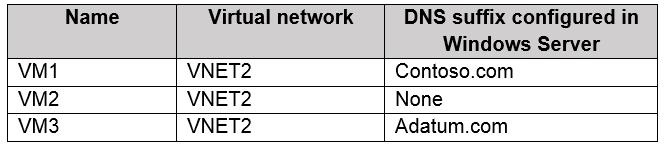
You have an Azure subscription. The subscription contains virtual machines that run Windows Server 2016 and are configured as shown in the following table.

You create a public Azure DNS zone named adatum.com and a private Azure DNS zone named contoso.com.

You create a virtual network link for contoso.com as shown in the following exhibit.

For each of the following statements, select Yes if the statement is true. Otherwise, select No.

NOTE: Each correct selection is worth one point.

Hot Area:

Question 212

Question 213

Open question ↗

Note: This question is part of a series of questions that present the same scenario. Each question in the series contains a unique solution that might meet the stated goals. Some question sets might have more than one correct solution, while others might not have a correct solution.

After you answer a question in this section, you will NOT be able to return to it. As a result, these questions will not appear in the review screen.

You have an Azure subscription that contains the following resources:

✑ A virtual network that has a subnet named Subnet1

✑ Two network security groups (NSGs) named NSG-VM1 and NSG-Subnet1

✑ A virtual machine named VM1 that has the required Windows Server configurations to allow Remote Desktop connections

NSG-Subnet1 has the default inbound security rules only.

NSG-VM1 has the default inbound security rules and the following custom inbound security rule:

✑ Priority: 100

✑ Source: Any

✑ Source port range: *

✑ Destination: *

✑ Destination port range: 3389

✑ Protocol: UDP

✑ Action: Allow

VM1 has a public IP address and is connected to Subnet1. NSG-VM1 is associated to the network interface of VM1. NSG-Subnet1 is associated to Subnet1.

You need to be able to establish Remote Desktop connections from the internet to VM1.

Solution: You add an inbound security rule to NSG-Subnet1 that allows connections from the Any source to the *destination for port range 3389 and uses the TCP protocol. You remove NSG-VM1 from the network interface of VM1.

Does this meet the goal?

  • A.Yes
  • B.No

Question 214

Open question ↗

Note: This question is part of a series of questions that present the same scenario. Each question in the series contains a unique solution that might meet the stated goals. Some question sets might have more than one correct solution, while others might not have a correct solution.

After you answer a question in this section, you will NOT be able to return to it. As a result, these questions will not appear in the review screen.

You have an Azure subscription that contains the following resources:

✑ A virtual network that has a subnet named Subnet1

✑ Two network security groups (NSGs) named NSG-VM1 and NSG-Subnet1

✑ A virtual machine named VM1 that has the required Windows Server configurations to allow Remote Desktop connections

NSG-Subnet1 has the default inbound security rules only.

NSG-VM1 has the default inbound security rules and the following custom inbound security rule:

✑ Priority: 100

✑ Source: Any

✑ Source port range: *

✑ Destination: *

✑ Destination port range: 3389

✑ Protocol: UDP

✑ Action: Allow

VM1 has a public IP address and is connected to Subnet1. NSG-VM1 is associated to the network interface of VM1. NSG-Subnet1 is associated to Subnet1.

You need to be able to establish Remote Desktop connections from the internet to VM1.

Solution: You add an inbound security rule to NSG-Subnet1 and NSG-VM1 that allows connections from the internet source to the VirtualNetwork destination for port range 3389 and uses the TCP protocol.

Does this meet the goal?

  • A.Yes
  • B.No

Question 215

Open question ↗

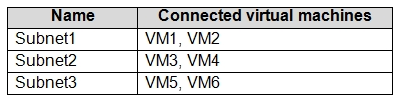
You have an Azure subscription that contains a virtual network named VNET1. VNET1 contains the subnets shown in the following table.

Each virtual machine uses a static IP address.

You need to create network security groups (NSGs) to meet following requirements:

✑ Allow web requests from the internet to VM3, VM4, VM5, and VM6.

✑ Allow all connections between VM1 and VM2.

✑ Allow Remote Desktop connections to VM1.

✑ Prevent all other network traffic to VNET1.

What is the minimum number of NSGs you should create?

Question 215
  • A.1
  • B.3
  • C.4
  • D.12

Question 216

Open question ↗

Your company has an Azure subscription named Subscription1.

The company also has two on-premises servers named Server1 and Server2 that run Windows Server 2016. Server1 is configured as a DNS server that has a primary DNS zone named adatum.com. Adatum.com contains 1,000 DNS records.

You manage Server1 and Subscription1 from Server2. Server2 has the following tools installed:

✑ The DNS Manager console

✑ Azure PowerShell

✑ Azure CLI 2.0

You need to move the adatum.com zone to an Azure DNS zone in Subscription1. The solution must minimize administrative effort.

What should you use?

  • A.Azure CLI
  • B.Azure PowerShell
  • C.the Azure portal
  • D.the DNS Manager console

Question 217

Open question ↗

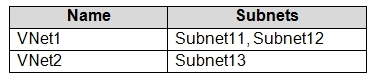
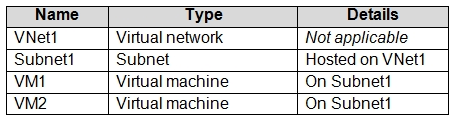
You have an Azure subscription named Subscription1 that contains the virtual networks in the following table.

Subscription1 contains the virtual machines in the following table.

In Subscription1, you create a load balancer that has the following configurations:

✑ Name: LB1

✑ SKU: Basic

✑ Type: Internal

✑ Subnet: Subnet12

✑ Virtual network: VNET1

For each of the following statements, select Yes if the statement is true. Otherwise, select No.

NOTE: Each correct selection is worth one point.

Hot Area:

Question 217

Question 218

Open question ↗

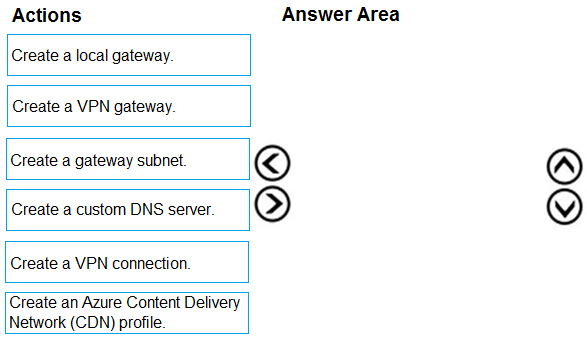
You have an on-premises network that you plan to connect to Azure by using a site-so-site VPN.

In Azure, you have an Azure virtual network named VNet1 that uses an address space of 10.0.0.0/16 VNet1 contains a subnet named Subnet1 that uses an address space of 10.0.0.0/24.

You need to create a site-to-site VPN to Azure.

Which four actions should you perform in sequence? To answer, move the appropriate actions from the list of actions to the answer area and arrange them in the correct order.

NOTE: More than one order of answer choice is correct. You will receive credit for any of the correct orders you select.

Select and Place:

Question 218

Question 219

Open question ↗

You have an Azure subscription that contains the resources in the following table.

VM1 and VM2 are deployed from the same template and host line-of-business applications.

You configure the network security group (NSG) shown in the exhibit. (Click the Exhibit tab.)

You need to prevent users of VM1 and VM2 from accessing websites on the Internet over TCP port 80.

What should you do?

Question 219
  • A.Disassociate the NSG from a network interface
  • B.Change the Port_80 inbound security rule.
  • C.Associate the NSG to Subnet1.
  • D.Change the DenyWebSites outbound security rule.

Question 220

Open question ↗

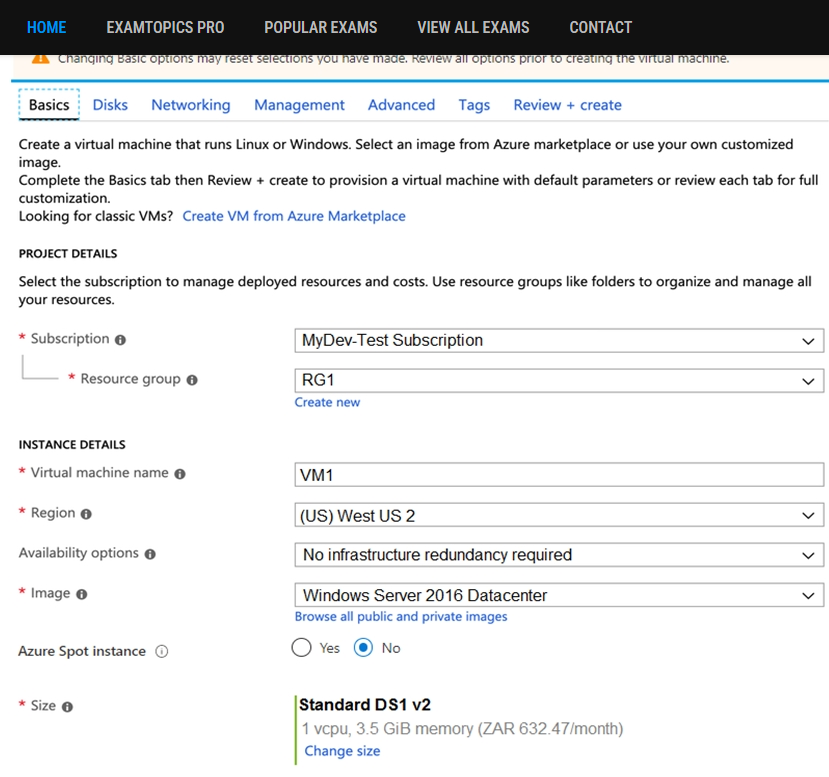
You plan to create an Azure virtual machine named VM1 that will be configured as shown in the following exhibit.

The planned disk configurations for VM1 are shown in the following exhibit.

You need to ensure that VM1 can be created in an Availability Zone.

Which two settings should you modify? Each correct answer presents part of the solution.

NOTE: Each correct selection is worth one point.

Question 220
  • A.Use managed disks
  • B.OS disk type
  • C.Availability options
  • D.Size
  • E.Image