FEFreeExamDumps.in

AZ-104 Practice Questions — Page 23

Question 221

Open question ↗

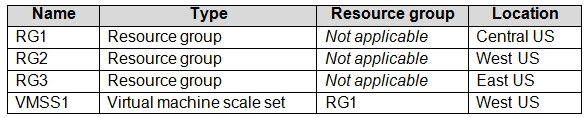
You have an Azure subscription that contains the resources shown in the following table.

VMSS1 is set to VM (virtual machines) orchestration mode.

You need to deploy a new Azure virtual machine named VM1, and then add VM1 to VMSS1.

Which resource group and location should you use to deploy VM1? To answer, select the appropriate options in the answer area.

NOTE: Each correct selection is worth one point.

Hot Area:
Question 221

Question 222

Open question ↗

Note: This question is part of a series of questions that present the same scenario. Each question in the series contains a unique solution that might meet the stated goals. Some question sets might have more than one correct solution, while others might not have a correct solution.

After you answer a question in this section, you will NOT be able to return to it. As a result, these questions will not appear in the review screen.

You have a computer named Computer1 that has a point-to-site VPN connection to an Azure virtual network named VNet1. The point-to-site connection uses a self-signed certificate.

From Azure, you download and install the VPN client configuration package on a computer named Computer2.

You need to ensure that you can establish a point-to-site VPN connection to VNet1 from Computer2.

Solution: You modify the Azure Active Directory (Azure AD) authentication policies.

Does this meet the goal?

  • A.Yes
  • B.No

Question 223

Open question ↗

Note: This question is part of a series of questions that present the same scenario. Each question in the series contains a unique solution that might meet the stated goals. Some question sets might have more than one correct solution, while others might not have a correct solution.

After you answer a question in this section, you will NOT be able to return to it. As a result, these questions will not appear in the review screen.

You have a computer named Computer1 that has a point-to-site VPN connection to an Azure virtual network named VNet1. The point-to-site connection uses a self-signed certificate.

From Azure, you download and install the VPN client configuration package on a computer named Computer2.

You need to ensure that you can establish a point-to-site VPN connection to VNet1 from Computer2.

Solution: You join Computer2 to Azure Active Directory (Azure AD).

Does this meet the goal?

  • A.Yes
  • B.No

Question 224

Open question ↗

Note: This question is part of a series of questions that present the same scenario. Each question in the series contains a unique solution that might meet the stated goals. Some question sets might have more than one correct solution, while others might not have a correct solution.

After you answer a question in this section, you will NOT be able to return to it. As a result, these questions will not appear in the review screen.

You have an Azure subscription that contains 10 virtual networks. The virtual networks are hosted in separate resource groups.

Another administrator plans to create several network security groups (NSGs) in the subscription.

You need to ensure that when an NSG is created, it automatically blocks TCP port 8080 between the virtual networks.

Solution: You create a resource lock, and then you assign the lock to the subscription.

Does this meet the goal?

  • A.Yes
  • B.No

Question 225

Open question ↗

You have an Azure subscription named Subscription1. Subscription1 contains a virtual machine named VM1.

You have a computer named Computer1 that runs Windows 10. Computer1 is connected to the Internet.

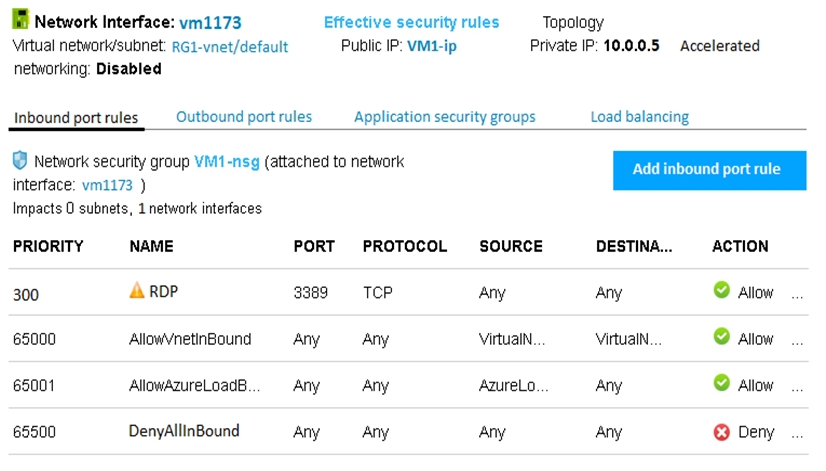
You add a network interface named vm1173 to VM1 as shown in the exhibit. (Click the Exhibit tab.)

From Computer1, you attempt to connect to VM1 by using Remote Desktop, but the connection fails.

You need to establish a Remote Desktop connection to VM1.

What should you do first?

Question 225
  • A.Change the priority of the RDP rule
  • B.Attach a network interface
  • C.Delete the DenyAllInBound rule
  • D.Start VM1

Question 226

Open question ↗

You have an Azure subscription named Subscription1 that contains an Azure virtual network named VNet1. VNet1 connects to your on-premises network by using

Azure ExpressRoute.

You plan to prepare the environment for automatic failover in case of ExpressRoute failure.

You need to connect VNet1 to the on-premises network by using a site-to-site VPN. The solution must minimize cost.

Which three actions should you perform? Each correct answer presents part of the solution.

NOTE: Each correct selection is worth one point.

  • A.Create a connection
  • B.Create a local site VPN gateway
  • C.Create a VPN gateway that uses the VpnGw1 SKU
  • D.Create a gateway subnet
  • E.Create a VPN gateway that uses the Basic SKU

Question 227

Open question ↗

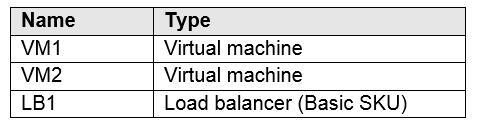
You have an Azure subscription that contains the resources in the following table.

You install the Web Server server role (IIS) on VM1 and VM2, and then add VM1 and VM2 to LB1.

LB1 is configured as shown in the LB1 exhibit. (Click the LB1 tab.)

Rule1 is configured as shown in the Rule1 exhibit. (Click the Rule1 tab.)

For each of the following statements, select Yes if the statement is true. Otherwise, select No.

NOTE: Each correct selection is worth one point.

Hot Area:

Question 227

Question 228

Open question ↗

You have an Azure virtual machine named VM1 that connects to a virtual network named VNet1. VM1 has the following configurations:

✑ Subnet: 10.0.0.0/24

✑ Availability set: AVSet

✑ Network security group (NSG): None

✑ Private IP address: 10.0.0.4 (dynamic)

✑ Public IP address: 40.90.219.6 (dynamic)

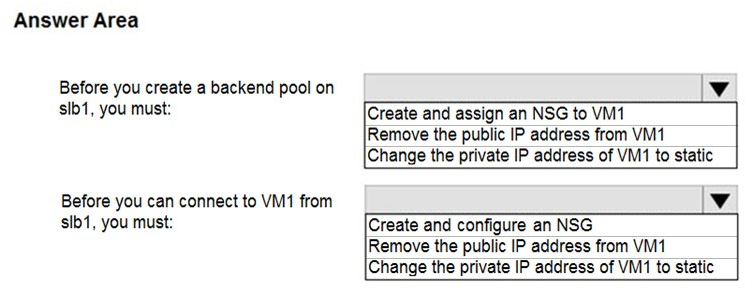
You deploy a standard, Internet-facing load balancer named slb1.

You need to configure slb1 to allow connectivity to VM1.

Which changes should you apply to VM1 as you configure slb1? To answer, select the appropriate options in the answer area.

NOTE: Each correct selection is worth one point.

Hot Area:
Question 228

Question 229

Open question ↗

You have an Azure subscription that contains the resource groups shown in the following table.

RG1 contains the resources shown in the following table.

You need to identify which resources you can move from RG1 to RG2, and which resources you can move from RG2 to RG1.

Which resources should you identify? To answer, select the appropriate options in the answer area.

NOTE: Each correct selection is worth one point.

Hot Area:
Question 229

Question 230

Open question ↗

Note: This question is part of a series of questions that present the same scenario. Each question in the series contains a unique solution that might meet the stated goals. Some question sets might have more than one correct solution, while others might not have a correct solution.

After you answer a question in this section, you will NOT be able to return to it. As a result, these questions will not appear in the review screen.

You have an Azure subscription that contains the virtual machines shown in the following table.

You deploy a load balancer that has the following configurations:

✑ Name: LB1

✑ Type: Internal

✑ SKU: Standard

✑ Virtual network: VNET1

You need to ensure that you can add VM1 and VM2 to the backend pool of LB1.

Solution: You create a Basic SKU public IP address, associate the address to the network interface of VM1, and then start VM1.

Does this meet the goal?

Question 230
  • A.Yes
  • B.No