FEFreeExamDumps.in

AZ-104 Practice Questions — Page 24

Question 231

Open question ↗

Note: This question is part of a series of questions that present the same scenario. Each question in the series contains a unique solution that might meet the stated goals. Some question sets might have more than one correct solution, while others might not have a correct solution.

After you answer a question in this section, you will NOT be able to return to it. As a result, these questions will not appear in the review screen.

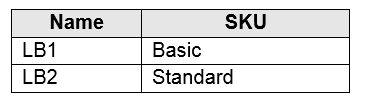
You have an Azure subscription that contains the virtual machines shown in the following table.

You deploy a load balancer that has the following configurations:

✑ Name: LB1

✑ Type: Internal

✑ SKU: Standard

✑ Virtual network: VNET1

You need to ensure that you can add VM1 and VM2 to the backend pool of LB1.

Solution: You create a Standard SKU public IP address, associate the address to the network interface of VM1, and then stop VM2.

Does this meet the goal?

Question 231
  • A.Yes
  • B.No

Question 232

Open question ↗

You have an Azure virtual machine named VM1.

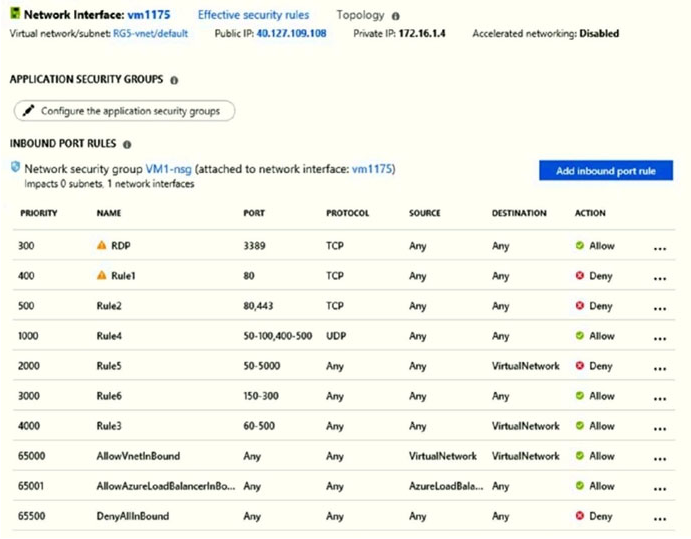
The network interface for VM1 is configured as shown in the exhibit. (Click the Exhibit tab.)

You deploy a web server on VM1, and then create a secure website that is accessible by using the HTTPS protocol. VM1 is used as a web server only.

You need to ensure that users can connect to the website from the Internet.

What should you do?

Question 232
  • A.Modify the protocol of Rule4
  • B.Delete Rule1
  • C.For Rule5, change the Action to Allow and change the priority to 401
  • D.Create a new inbound rule that allows TCP protocol 443 and configure the rule to have a priority of 501.

Question 233

Open question ↗

Note: This question is part of a series of questions that present the same scenario. Each question in the series contains a unique solution that might meet the stated goals. Some question sets might have more than one correct solution, while others might not have a correct solution.

After you answer a question in this section, you will NOT be able to return to it. As a result, these questions will not appear in the review screen.

You have an Azure subscription that contains 10 virtual networks. The virtual networks are hosted in separate resource groups.

Another administrator plans to create several network security groups (NSGs) in the subscription.

You need to ensure that when an NSG is created, it automatically blocks TCP port 8080 between the virtual networks.

Solution: From the Resource providers blade, you unregister the Microsoft.ClassicNetwork provider.

Does this meet the goal?

  • A.Yes
  • B.No

Question 234

Open question ↗

You manage two Azure subscriptions named Subscription1 and Subscription2.

Subscription1 has following virtual networks:

The virtual networks contain the following subnets:

Subscription2 contains the following virtual network:

✑ Name: VNETA

✑ Address space: 10.10.128.0/17

✑ Location: Canada Central

VNETA contains the following subnets:

For each of the following statements, select Yes if the statement is true. Otherwise, select No.

NOTE: Each correct selection is worth one point.

Hot Area:

Question 234

Question 235

Open question ↗

Note: This question is part of a series of questions that present the same scenario. Each question in the series contains a unique solution that might meet the stated goals. Some question sets might have more than one correct solution, while others might not have a correct solution.

After you answer a question in this section, you will NOT be able to return to it. As a result, these questions will not appear in the review screen.

You have an app named App1 that is installed on two Azure virtual machines named VM1 and VM2. Connections to App1 are managed by using an Azure Load

Balancer.

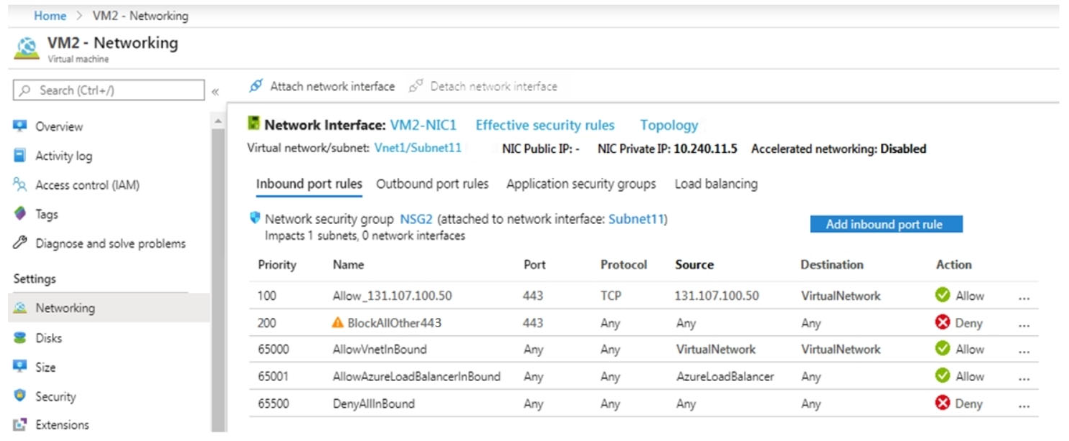
The effective network security configurations for VM2 are shown in the following exhibit.

You discover that connections to App1 from 131.107.100.50 over TCP port 443 fail.

You verify that the Load Balancer rules are configured correctly.

You need to ensure that connections to App1 can be established successfully from 131.107.100.50 over TCP port 443.

Solution: You delete the BlockAllOther443 inbound security rule.

Does this meet the goal?

Question 235
  • A.Yes
  • B.No

Question 236

Open question ↗

Note: This question is part of a series of questions that present the same scenario. Each question in the series contains a unique solution that might meet the stated goals. Some question sets might have more than one correct solution, while others might not have a correct solution.

After you answer a question in this section, you will NOT be able to return to it. As a result, these questions will not appear in the review screen.

You have an Azure subscription that contains the virtual machines shown in the following table.

You deploy a load balancer that has the following configurations:

✑ Name: LB1

✑ Type: Internal

✑ SKU: Standard

✑ Virtual network: VNET1

You need to ensure that you can add VM1 and VM2 to the backend pool of LB1.

Solution: You disassociate the public IP address from the network interface of VM2.

Does this meet the goal?

Question 236
  • A.Yes
  • B.No

Question 237

Open question ↗

You have an Azure subscription that contains the public load balancers shown in the following table.

You plan to create six virtual machines and to load balance requests to the virtual machines. Each load balancer will load balance three virtual machines.

You need to create the virtual machines for the planned solution.

How should you create the virtual machines? To answer, select the appropriate options in the answer area.

NOTE: Each correct selection is worth one point.

Hot Area:

Question 237

Question 238

Open question ↗

You have an on-premises data center and an Azure subscription. The data center contains two VPN devices. The subscription contains an Azure virtual network named VNet1. VNet1 contains a gateway subnet.

You need to create a site-to-site VPN. The solution must ensure that if a single instance of an Azure VPN gateway fails, or a single on-premises VPN device fails, the failure will not cause an interruption that is longer than two minutes.

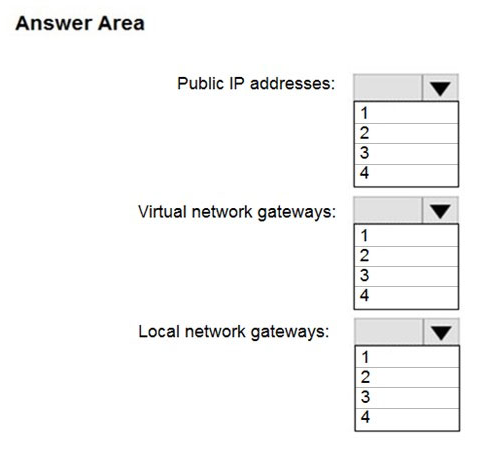
What is the minimum number of public IP addresses, virtual network gateways, and local network gateways required in Azure? To answer, select the appropriate options in the answer area.

NOTE: Each correct selection is worth one point.

Hot Area:

Question 238

Question 239

Open question ↗

You have an Azure subscription that contains two virtual machines as shown in the following table.

You perform a reverse DNS lookup for 10.0.0.4 from VM2.

Which FQDN will be returned?

Question 239
  • A.vm1.core.windows.net
  • B.vm1.azure.com
  • C.vm1.westeurope.cloudapp.azure.com
  • D.vm1.internal.cloudapp.net

Question 240

Open question ↗

You have an Azure subscription that contains a policy-based virtual network gateway named GW1 and a virtual network named VNet1.

You need to ensure that you can configure a point-to-site connection from an on-premises computer to VNet1.

Which two actions should you perform? Each correct answer presents part of the solution.

NOTE: Each correct selection is worth one point.

  • A.Add a service endpoint to VNet1
  • B.Reset GW1
  • C.Create a route-based virtual network gateway
  • D.Add a connection to GW1
  • E.Delete GW1
  • F.Add a public IP address space to VNet1