FEFreeExamDumps.in

DP-203 Practice Questions — Page 12

Question 111

Open question ↗

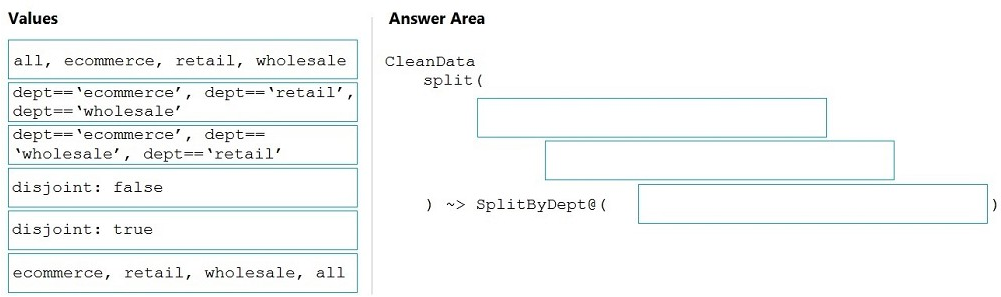
You need to create an Azure Data Factory pipeline to process data for the following three departments at your company: Ecommerce, retail, and wholesale. The solution must ensure that data can also be processed for the entire company.

How should you complete the Data Factory data flow script? To answer, drag the appropriate values to the correct targets. Each value may be used once, more than once, or not at all. You may need to drag the split bar between panes or scroll to view content.

NOTE: Each correct selection is worth one point.

Select and Place:
Question 111

Question 112

Open question ↗

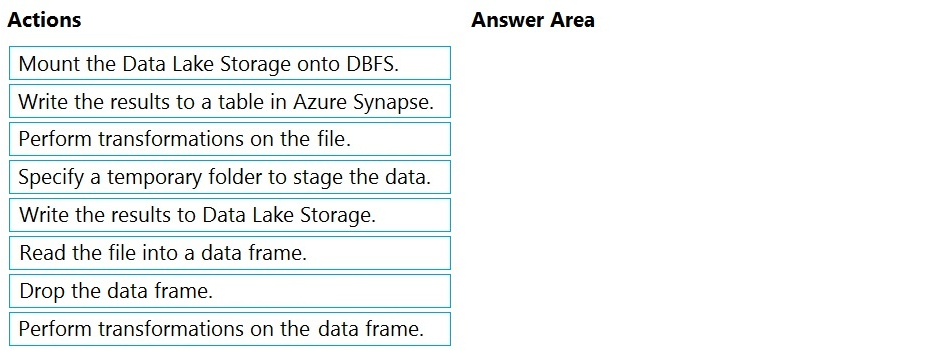
You have an Azure Data Lake Storage Gen2 account that contains a JSON file for customers. The file contains two attributes named FirstName and LastName.

You need to copy the data from the JSON file to an Azure Synapse Analytics table by using Azure Databricks. A new column must be created that concatenates the FirstName and LastName values.

You create the following components:

✑ A destination table in Azure Synapse

✑ An Azure Blob storage container

✑ A service principal

Which five actions should you perform in sequence next in is Databricks notebook? To answer, move the appropriate actions from the list of actions to the answer area and arrange them in the correct order.

Select and Place:

Question 112

Question 113

Open question ↗

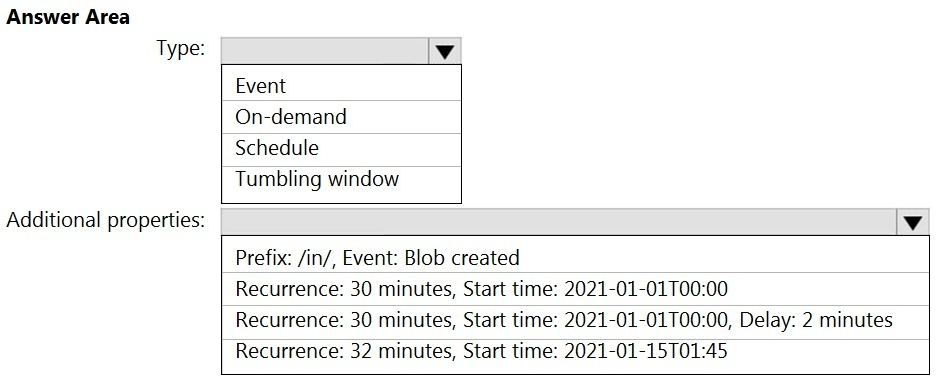
You build an Azure Data Factory pipeline to move data from an Azure Data Lake Storage Gen2 container to a database in an Azure Synapse Analytics dedicated

SQL pool.

Data in the container is stored in the following folder structure.

/in/{YYYY}/{MM}/{DD}/{HH}/{mm}

The earliest folder is /in/2021/01/01/00/00. The latest folder is /in/2021/01/15/01/45.

You need to configure a pipeline trigger to meet the following requirements:

✑ Existing data must be loaded.

✑ Data must be loaded every 30 minutes.

✑ Late-arriving data of up to two minutes must be included in the load for the time at which the data should have arrived.

How should you configure the pipeline trigger? To answer, select the appropriate options in the answer area.

NOTE: Each correct selection is worth one point.

Hot Area:

Question 113

Question 114

Open question ↗

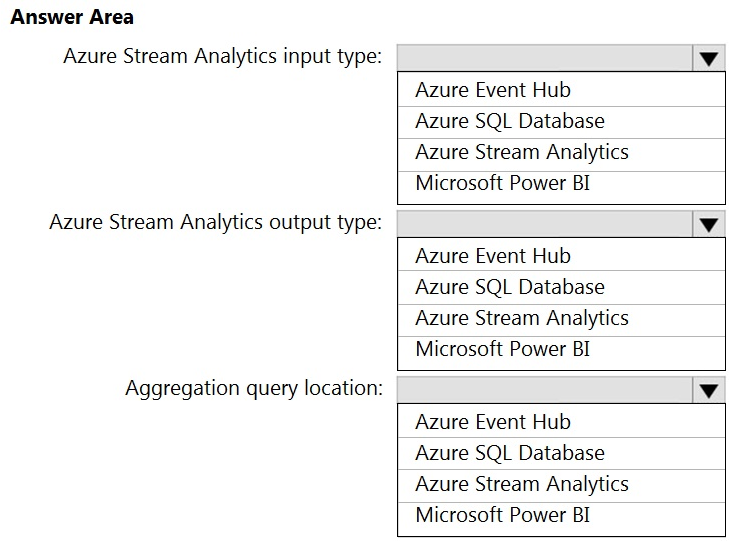
You are designing a near real-time dashboard solution that will visualize streaming data from remote sensors that connect to the internet. The streaming data must be aggregated to show the average value of each 10-second interval. The data will be discarded after being displayed in the dashboard.

The solution will use Azure Stream Analytics and must meet the following requirements:

✑ Minimize latency from an Azure Event hub to the dashboard.

✑ Minimize the required storage.

✑ Minimize development effort.

What should you include in the solution? To answer, select the appropriate options in the answer area.

NOTE: Each correct selection is worth one point

Hot Area:

Question 114

Question 115

Open question ↗

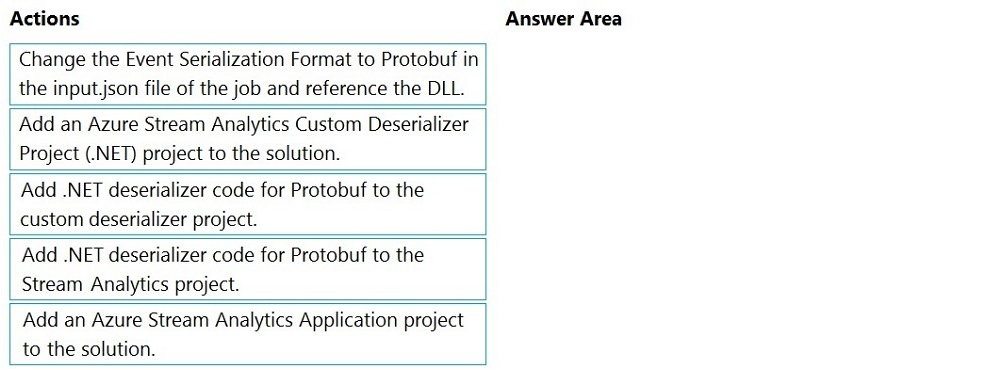
You have an Azure Stream Analytics job that is a Stream Analytics project solution in Microsoft Visual Studio. The job accepts data generated by IoT devices in the JSON format.

You need to modify the job to accept data generated by the IoT devices in the Protobuf format.

Which three actions should you perform from Visual Studio on sequence? To answer, move the appropriate actions from the list of actions to the answer area and arrange them in the correct order.

Select and Place:

Question 115

Question 116

Open question ↗

You have an Azure Storage account and a data warehouse in Azure Synapse Analytics in the UK South region.

You need to copy blob data from the storage account to the data warehouse by using Azure Data Factory. The solution must meet the following requirements:

✑ Ensure that the data remains in the UK South region at all times.

✑ Minimize administrative effort.

Which type of integration runtime should you use?

  • A.Azure integration runtime
  • B.Azure-SSIS integration runtime
  • C.Self-hosted integration runtime

Question 117

Open question ↗

You have an Azure Stream Analytics job that receives clickstream data from an Azure event hub.

You need to define a query in the Stream Analytics job. The query must meet the following requirements:

✑ Count the number of clicks within each 10-second window based on the country of a visitor.

✑ Ensure that each click is NOT counted more than once.

How should you define the Query?

  • A.SELECT Country, Avg(*) AS Average FROM ClickStream TIMESTAMP BY CreatedAt GROUP BY Country, SlidingWindow(second, 10)
  • B.SELECT Country, Count(*) AS Count FROM ClickStream TIMESTAMP BY CreatedAt GROUP BY Country, TumblingWindow(second, 10)
  • C.SELECT Country, Avg(*) AS Average FROM ClickStream TIMESTAMP BY CreatedAt GROUP BY Country, HoppingWindow(second, 10, 2)
  • D.SELECT Country, Count(*) AS Count FROM ClickStream TIMESTAMP BY CreatedAt GROUP BY Country, SessionWindow(second, 5, 10)

Question 118

Open question ↗

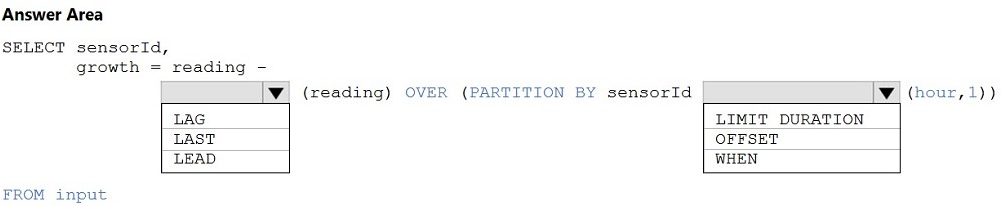
You are building an Azure Analytics query that will receive input data from Azure IoT Hub and write the results to Azure Blob storage.

You need to calculate the difference in the number of readings per sensor per hour.

How should you complete the query? To answer, select the appropriate options in the answer area.

NOTE: Each correct selection is worth one point.

Hot Area:

Question 118

Question 119

Open question ↗

You need to schedule an Azure Data Factory pipeline to execute when a new file arrives in an Azure Data Lake Storage Gen2 container.

Which type of trigger should you use?

  • A.on-demand
  • B.tumbling window
  • C.schedule
  • D.event

Question 120

Open question ↗

You have two Azure Data Factory instances named ADFdev and ADFprod. ADFdev connects to an Azure DevOps Git repository.

You publish changes from the main branch of the Git repository to ADFdev.

You need to deploy the artifacts from ADFdev to ADFprod.

What should you do first?

  • A.From ADFdev, modify the Git configuration.
  • B.From ADFdev, create a linked service.
  • C.From Azure DevOps, create a release pipeline.
  • D.From Azure DevOps, update the main branch.