FEFreeExamDumps.in

DP-203 Practice Questions — Page 13

Question 121

Open question ↗

You are developing a solution that will stream to Azure Stream Analytics. The solution will have both streaming data and reference data.

Which input type should you use for the reference data?

  • A.Azure Cosmos DB
  • B.Azure Blob storage
  • C.Azure IoT Hub
  • D.Azure Event Hubs

Question 122

Open question ↗

You are designing an Azure Stream Analytics job to process incoming events from sensors in retail environments.

You need to process the events to produce a running average of shopper counts during the previous 15 minutes, calculated at five-minute intervals.

Which type of window should you use?

  • A.snapshot
  • B.tumbling
  • C.hopping
  • D.sliding

Question 123

Open question ↗

You are designing an Azure Databricks table. The table will ingest an average of 20 million streaming events per day.

You need to persist the events in the table for use in incremental load pipeline jobs in Azure Databricks. The solution must minimize storage costs and incremental load times.

What should you include in the solution?

  • A.Partition by DateTime fields.
  • B.Sink to Azure Queue storage.
  • C.Include a watermark column.
  • D.Use a JSON format for physical data storage.

Question 124

Open question ↗

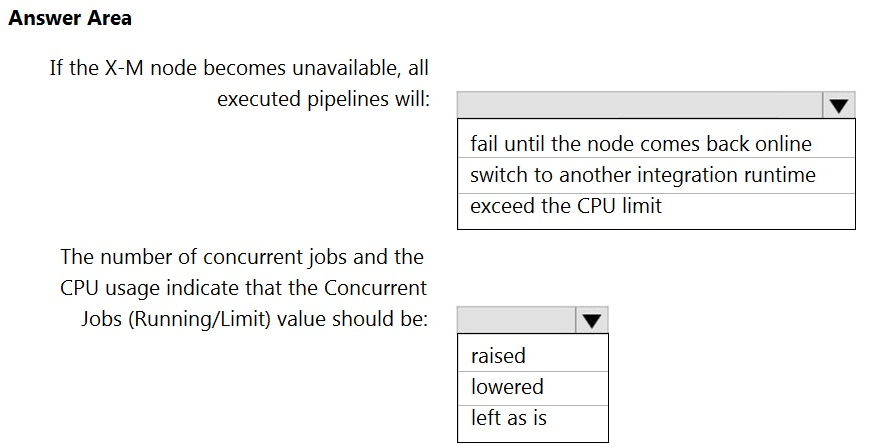
You have a self-hosted integration runtime in Azure Data Factory.

The current status of the integration runtime has the following configurations:

✑ Status: Running

✑ Type: Self-Hosted

✑ Version: 4.4.7292.1

✑ Running / Registered Node(s): 1/1

✑ High Availability Enabled: False

✑ Linked Count: 0

✑ Queue Length: 0

✑ Average Queue Duration. 0.00s

The integration runtime has the following node details:

✑ Name: X-M

✑ Status: Running

✑ Version: 4.4.7292.1

✑ Available Memory: 7697MB

✑ CPU Utilization: 6%

✑ Network (In/Out): 1.21KBps/0.83KBps

✑ Concurrent Jobs (Running/Limit): 2/14

✑ Role: Dispatcher/Worker

✑ Credential Status: In Sync

Use the drop-down menus to select the answer choice that completes each statement based on the information presented.

NOTE: Each correct selection is worth one point.

Hot Area:

Question 124

Question 125

Open question ↗

You use Azure Stream Analytics to receive data from Azure Event Hubs and to output the data to an Azure Blob Storage account.

You need to output the count of records received from the last five minutes every minute.

Which windowing function should you use?

  • A.Session
  • B.Tumbling
  • C.Sliding
  • D.Hopping

Question 126

Open question ↗

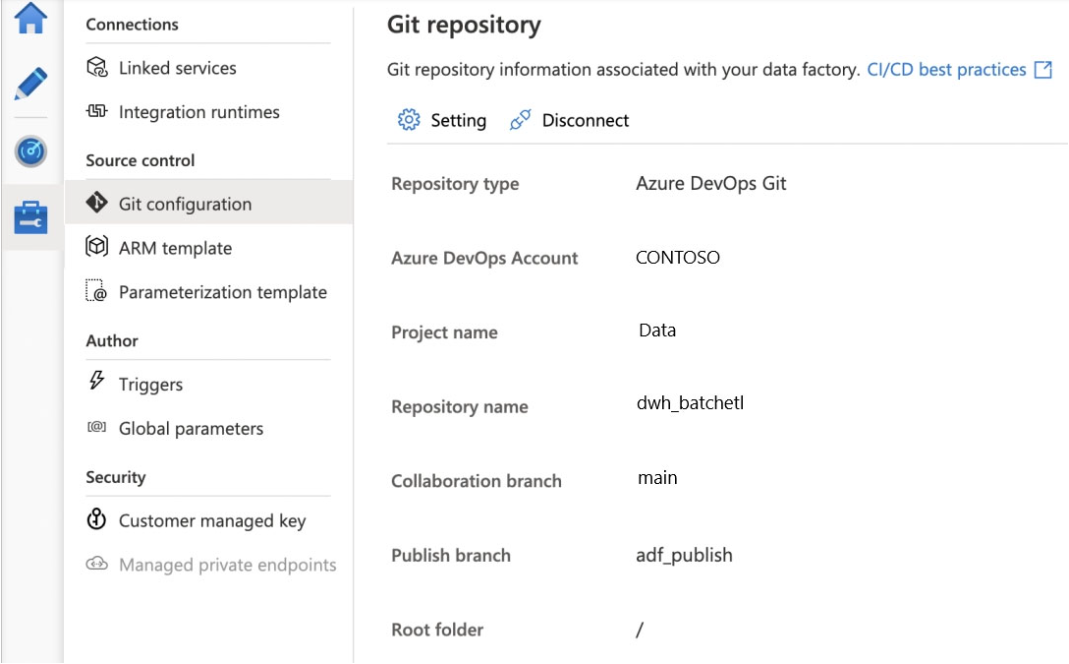
You configure version control for an Azure Data Factory instance as shown in the following exhibit.

Use the drop-down menus to select the answer choice that completes each statement based on the information presented in the graphic.

NOTE: Each correct selection is worth one point.

Hot Area:

Question 126

Question 127

Open question ↗

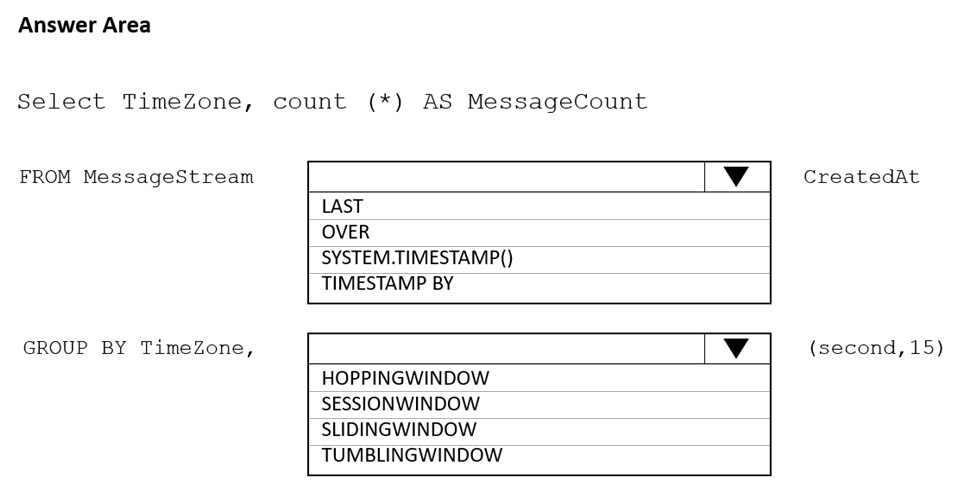
You are designing an Azure Stream Analytics solution that receives instant messaging data from an Azure Event Hub.

You need to ensure that the output from the Stream Analytics job counts the number of messages per time zone every 15 seconds.

How should you complete the Stream Analytics query? To answer, select the appropriate options in the answer area.

NOTE: Each correct selection is worth one point.

Hot Area:

Question 127

Question 128

Open question ↗

You have an Azure Data Factory instance named ADF1 and two Azure Synapse Analytics workspaces named WS1 and WS2.

ADF1 contains the following pipelines:

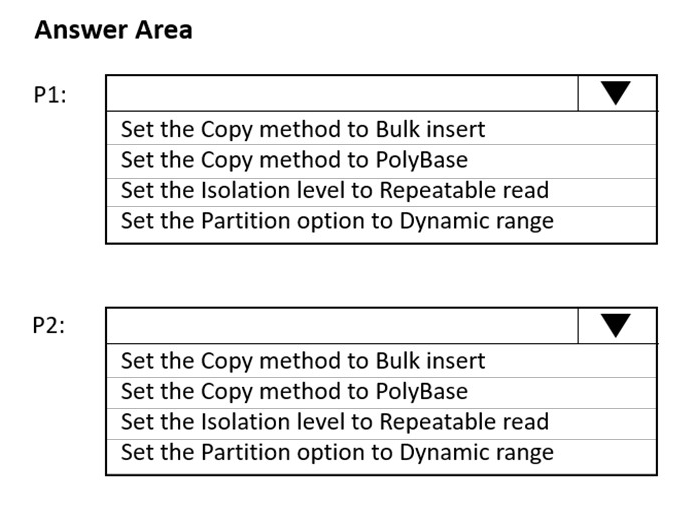
✑ P1: Uses a copy activity to copy data from a nonpartitioned table in a dedicated SQL pool of WS1 to an Azure Data Lake Storage Gen2 account

✑ P2: Uses a copy activity to copy data from text-delimited files in an Azure Data Lake Storage Gen2 account to a nonpartitioned table in a dedicated SQL pool of WS2

You need to configure P1 and P2 to maximize parallelism and performance.

Which dataset settings should you configure for the copy activity if each pipeline? To answer, select the appropriate options in the answer area.

NOTE: Each correct selection is worth one point.

Hot Area:

Question 128

Question 129

Open question ↗

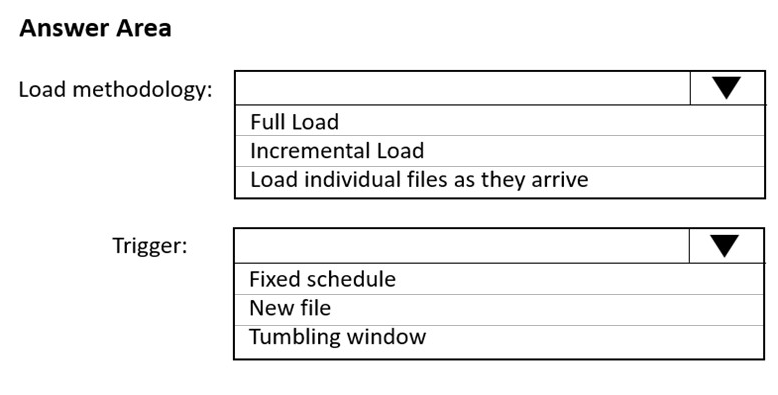
You have an Azure Storage account that generates 200,000 new files daily. The file names have a format of {YYYY}/{MM}/{DD}/{HH}/{CustomerID}.csv.

You need to design an Azure Data Factory solution that will load new data from the storage account to an Azure Data Lake once hourly. The solution must minimize load times and costs.

How should you configure the solution? To answer, select the appropriate options in the answer area.

NOTE: Each correct selection is worth one point.

Hot Area:

Question 129

Question 130

Open question ↗

Note: This question is part of a series of questions that present the same scenario. Each question in the series contains a unique solution that might meet the stated goals. Some question sets might have more than one correct solution, while others might not have a correct solution.

After you answer a question in this section, you will NOT be able to return to it. As a result, these questions will not appear in the review screen.

You plan to create an Azure Databricks workspace that has a tiered structure. The workspace will contain the following three workloads:

✑ A workload for data engineers who will use Python and SQL.

✑ A workload for jobs that will run notebooks that use Python, Scala, and SQL.

✑ A workload that data scientists will use to perform ad hoc analysis in Scala and R.

The enterprise architecture team at your company identifies the following standards for Databricks environments:

✑ The data engineers must share a cluster.

✑ The job cluster will be managed by using a request process whereby data scientists and data engineers provide packaged notebooks for deployment to the cluster.

✑ All the data scientists must be assigned their own cluster that terminates automatically after 120 minutes of inactivity. Currently, there are three data scientists.

You need to create the Databricks clusters for the workloads.

Solution: You create a Standard cluster for each data scientist, a Standard cluster for the data engineers, and a High Concurrency cluster for the jobs.

Does this meet the goal?
  • A.Yes
  • B.No