FEFreeExamDumps.in

DP-203 Practice Questions — Page 14

Question 131

Open question ↗

You have the following Azure Data Factory pipelines:

✑ Ingest Data from System1

✑ Ingest Data from System2

✑ Populate Dimensions

✑ Populate Facts

Ingest Data from System1 and Ingest Data from System2 have no dependencies. Populate Dimensions must execute after Ingest Data from System1 and Ingest

Data from System2. Populate Facts must execute after Populate Dimensions pipeline. All the pipelines must execute every eight hours.

What should you do to schedule the pipelines for execution?

  • A.Add an event trigger to all four pipelines.
  • B.Add a schedule trigger to all four pipelines.
  • C.Create a patient pipeline that contains the four pipelines and use a schedule trigger.
  • D.Create a patient pipeline that contains the four pipelines and use an event trigger.
Question 132

Open question ↗

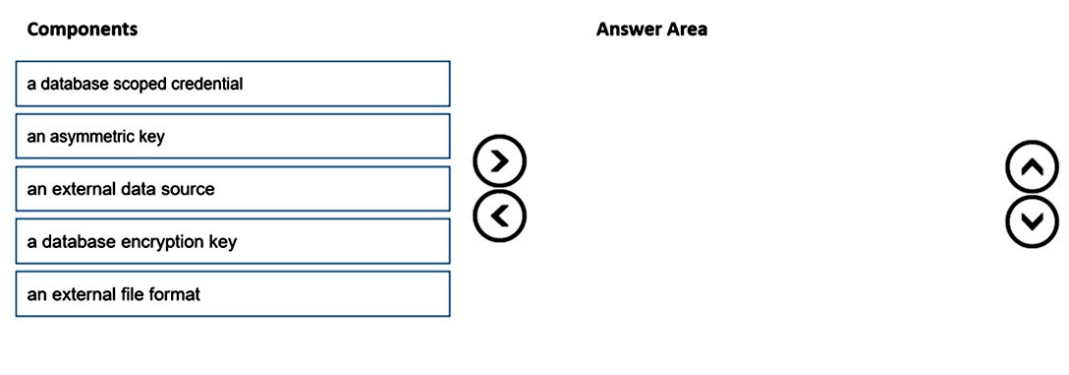
You are responsible for providing access to an Azure Data Lake Storage Gen2 account.

Your user account has contributor access to the storage account, and you have the application ID and access key.

You plan to use PolyBase to load data into an enterprise data warehouse in Azure Synapse Analytics.

You need to configure PolyBase to connect the data warehouse to storage account.

Which three components should you create in sequence? To answer, move the appropriate components from the list of components to the answer area and arrange them in the correct order.

Select and Place:

Question 132

Question 133

Open question ↗

You are monitoring an Azure Stream Analytics job by using metrics in Azure.

You discover that during the last 12 hours, the average watermark delay is consistently greater than the configured late arrival tolerance.

What is a possible cause of this behavior?

  • A.Events whose application timestamp is earlier than their arrival time by more than five minutes arrive as inputs.
  • B.There are errors in the input data.
  • C.The late arrival policy causes events to be dropped.
  • D.The job lacks the resources to process the volume of incoming data.

Question 134

Open question ↗

Note: This question is part of a series of questions that present the same scenario. Each question in the series contains a unique solution that might meet the stated goals. Some question sets might have more than one correct solution, while others might not have a correct solution.

After you answer a question in this section, you will NOT be able to return to it. As a result, these questions will not appear in the review screen.

You have an Azure Data Lake Storage account that contains a staging zone.

You need to design a daily process to ingest incremental data from the staging zone, transform the data by executing an R script, and then insert the transformed data into a data warehouse in Azure Synapse Analytics.

Solution: You use an Azure Data Factory schedule trigger to execute a pipeline that copies the data to a staging table in the data warehouse, and then uses a stored procedure to execute the R script.

Does this meet the goal?

  • A.Yes
  • B.No

Question 135

Open question ↗

Note: This question is part of a series of questions that present the same scenario. Each question in the series contains a unique solution that might meet the stated goals. Some question sets might have more than one correct solution, while others might not have a correct solution.

After you answer a question in this section, you will NOT be able to return to it. As a result, these questions will not appear in the review screen.

You plan to create an Azure Databricks workspace that has a tiered structure. The workspace will contain the following three workloads:

✑ A workload for data engineers who will use Python and SQL.

✑ A workload for jobs that will run notebooks that use Python, Scala, and SQL.

✑ A workload that data scientists will use to perform ad hoc analysis in Scala and R.

The enterprise architecture team at your company identifies the following standards for Databricks environments:

✑ The data engineers must share a cluster.

✑ The job cluster will be managed by using a request process whereby data scientists and data engineers provide packaged notebooks for deployment to the cluster.

✑ All the data scientists must be assigned their own cluster that terminates automatically after 120 minutes of inactivity. Currently, there are three data scientists.

You need to create the Databricks clusters for the workloads.

Solution: You create a High Concurrency cluster for each data scientist, a High Concurrency cluster for the data engineers, and a Standard cluster for the jobs.

Does this meet the goal?

  • A.Yes
  • B.No

Question 136

Open question ↗

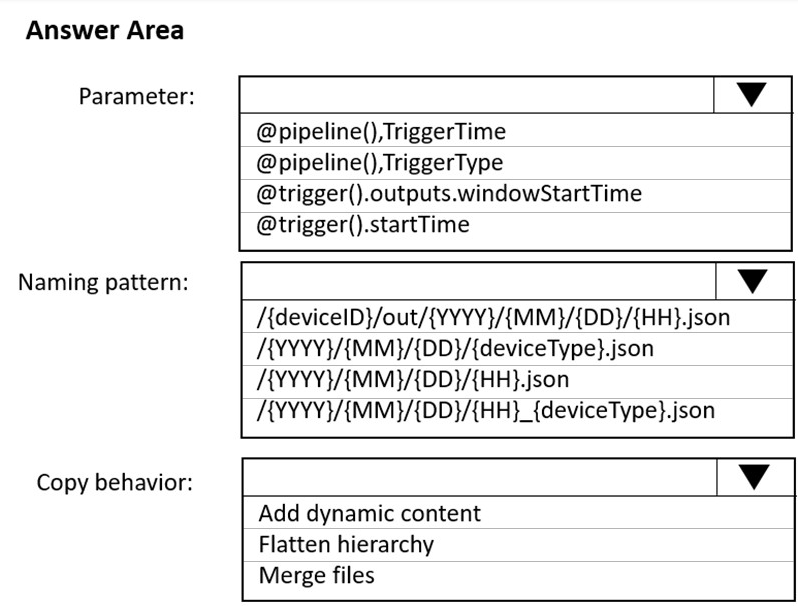
You are building an Azure Data Factory solution to process data received from Azure Event Hubs, and then ingested into an Azure Data Lake Storage Gen2 container.

The data will be ingested every five minutes from devices into JSON files. The files have the following naming pattern.

/{deviceType}/in/{YYYY}/{MM}/{DD}/{HH}/{deviceID}_{YYYY}{MM}{DD}HH}{mm}.json

You need to prepare the data for batch data processing so that there is one dataset per hour per deviceType. The solution must minimize read times.

How should you configure the sink for the copy activity? To answer, select the appropriate options in the answer area.

NOTE: Each correct selection is worth one point.

Hot Area:

Question 136

Question 137

Open question ↗

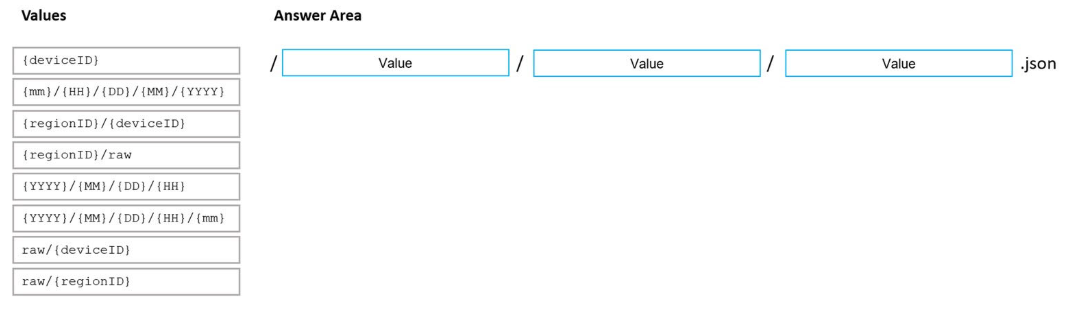
You are designing an Azure Data Lake Storage Gen2 structure for telemetry data from 25 million devices distributed across seven key geographical regions. Each minute, the devices will send a JSON payload of metrics to Azure Event Hubs.

You need to recommend a folder structure for the data. The solution must meet the following requirements:

✑ Data engineers from each region must be able to build their own pipelines for the data of their respective region only.

✑ The data must be processed at least once every 15 minutes for inclusion in Azure Synapse Analytics serverless SQL pools.

How should you recommend completing the structure? To answer, drag the appropriate values to the correct targets. Each value may be used once, more than once, or not at all. You may need to drag the split bar between panes or scroll to view content.

NOTE: Each correct selection is worth one point.

Select and Place:

Question 137

Question 138

Open question ↗

You are creating a new notebook in Azure Databricks that will support R as the primary language but will also support Scala and SQL.

Which switch should you use to switch between languages?

  • A.%<language>
  • B.@<Language >
  • C.\\[<language >]
  • D.\\(<language >)

Question 139

Open question ↗

You have an Azure Data Factory pipeline that performs an incremental load of source data to an Azure Data Lake Storage Gen2 account.

Data to be loaded is identified by a column named LastUpdatedDate in the source table.

You plan to execute the pipeline every four hours.

You need to ensure that the pipeline execution meets the following requirements:

✑ Automatically retries the execution when the pipeline run fails due to concurrency or throttling limits.

✑ Supports backfilling existing data in the table.

Which type of trigger should you use?

  • A.event
  • B.on-demand
  • C.schedule
  • D.tumbling window

Question 140

Open question ↗

You are designing a solution that will copy Parquet files stored in an Azure Blob storage account to an Azure Data Lake Storage Gen2 account.

The data will be loaded daily to the data lake and will use a folder structure of {Year}/{Month}/{Day}/.

You need to design a daily Azure Data Factory data load to minimize the data transfer between the two accounts.

Which two configurations should you include in the design? Each correct answer presents part of the solution.

NOTE: Each correct selection is worth one point

  • A.Specify a file naming pattern for the destination.
  • B.Delete the files in the destination before loading the data.
  • C.Filter by the last modified date of the source files.
  • D.Delete the source files after they are copied.