FEFreeExamDumps.in

DP-203 Practice Questions — Page 8

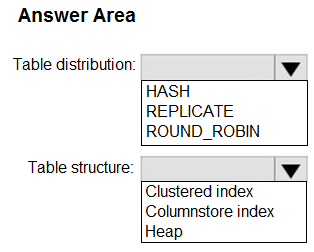
You are incrementally loading data into fact tables in an Azure Synapse Analytics dedicated SQL pool.

Each batch of incoming data is staged before being loaded into the fact tables.

You need to ensure that the incoming data is staged as quickly as possible.

How should you configure the staging tables? To answer, select the appropriate options in the answer area.

NOTE: Each correct selection is worth one point.
Question 71

You have an Azure subscription that contains an Azure Synapse Analytics workspace named ws1 and an Azure Cosmos DB database account named Cosmos1. Cosmos1 contains a container named container1 and ws1 contains a serverless SQL pool.

You need to ensure that you can query the data in container1 by using the serverless SQL pool.

Which three actions should you perform? Each correct answer presents part of the solution.

NOTE: Each correct selection is worth one point.

  • A.Enable Azure Synapse Link for Cosmos1.
  • B.Disable the analytical store for container1.
  • C.In ws1, create a linked service that references Cosmos1.
  • D.Enable the analytical store for container1.
  • E.Disable indexing for container1.

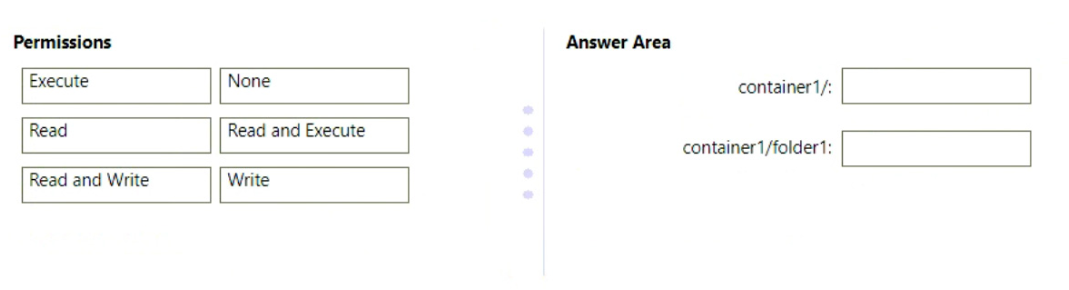
You have an Azure subscription that contains an Azure Data Lake Storage Gen2 account named account1 and a user named User1.

In account1, you create a container named container1. In container1, you create a folder named folder1.

You need to ensure that User1 can list and read all the files in folder1. The solution must use the principle of least privilege.

How should you configure the permissions for each folder? To answer, drag the appropriate permissions to the correct folders. Each permission may be used once, more than once, or not at all. You may need to drag the split bar between panes or scroll to view content.

NOTE: Each correct selection is worth one point.

Question 73

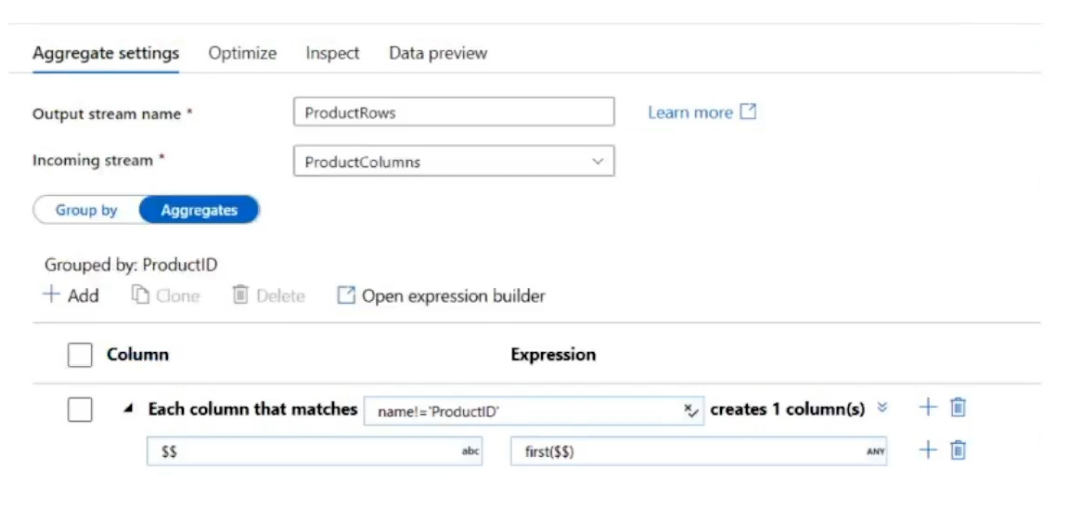
You have an Azure data factory named adf1 that contains a pipeline named ExecProduct. ExecProduct contains a data flow named Product.

The Product data flow contains the following transformations:

1. WeeklyData: A source that points to a CSV file in an Azure Data Lake Storage Gen2 account with 20 columns

2. ProductColumns: A select transformation that selects from WeeklyData six columns named ProductID, ProductDescr, ProductSubCategory, ProductCategory, ProductStatus, and ProductLastUpdated

3. ProductRows: An aggregate transformation

4. ProductList: A sink that outputs data to an Azure Synapse Analytics dedicated SQL pool

The Aggregate settings for ProductRows are configured as shown in the following exhibit.

For each of the following statements, select Yes if the statement is true. Otherwise, select No.

NOTE: Each correct selection is worth one point.

Question 74

You manage an enterprise data warehouse in Azure Synapse Analytics.

Users report slow performance when they run commonly used queries. Users do not report performance changes for infrequently used queries.

You need to monitor resource utilization to determine the source of the performance issues.

Which metric should you monitor?

  • A.DWU limit
  • B.Cache hit percentage
  • C.Local tempdb percentage
  • D.Data IO percentage

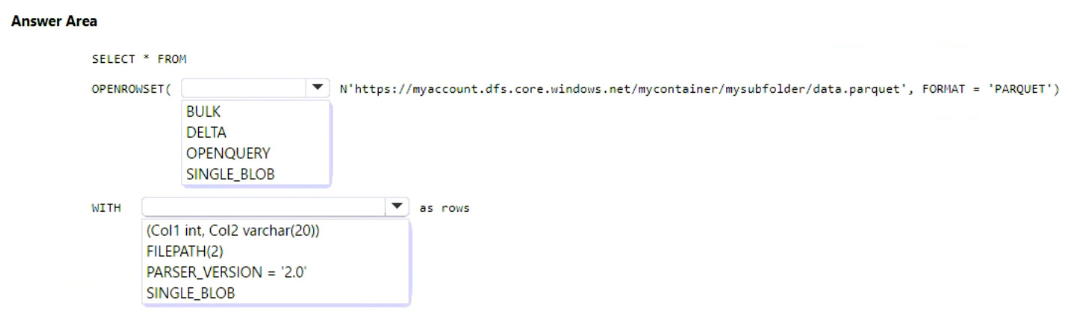
You have an Azure Synapse Analytics serverless SQL pool.

You have an Apache Parquet file that contains 10 columns.

You need to query data from the file. The solution must return only two columns.

How should you complete the query? To answer, select the appropriate options in the answer area.

NOTE: Each correct selection is worth one point.
Question 76

You have an Azure Synapse Analytics workspace that contains an Apache Spark pool named SparkPool1. SparkPool1 contains a Delta Lake table named SparkTable1.

You need to recommend a solution that supports Transact-SQL queries against the data referenced by SparkTable1. The solution must ensure that the queries can use partition elimination.

What should you include in the recommendation?

  • A.a partitioned table in a dedicated SQL pool
  • B.a partitioned view in a dedicated SQL pool
  • C.a partitioned index in a dedicated SQL pool
  • D.a partitioned view in a serverless SQL pool

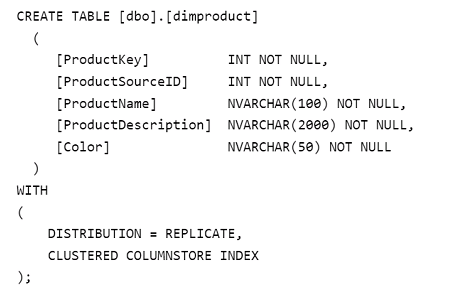
You are implementing a star schema in an Azure Synapse Analytics dedicated SQL pool.

You plan to create a table named DimProduct.

DimProduct must be a Type 3 slowly changing dimension (SCD) table that meets the following requirements:

• The values in two columns named ProductKey and ProductSourceID will remain the same.

• The values in three columns named ProductName, ProductDescription, and Color can change.

You need to add additional columns to complete the following table definition.

Which three columns should you add? Each correct answer presents part of the solution.

NOTE: Each correct selection is worth one point.

Question 78
  • A.[EffectiveStartDate] [datetime] NOT NULL
  • B.[EffectiveEndDate] [datetime] NOT NULL
  • C.[OriginalProductDescription] NVARCHAR(2000) NOT NULL
  • D.[IsCurrentRow] [bit] NOT NULL
  • E.[OriginalColor] NVARCHAR(50) NOT NULL
  • F.[OriginalProductName] NVARCHAR(100) NULL

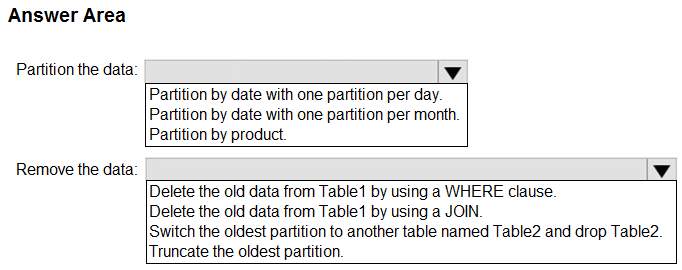
You have an Azure Synapse Analytics dedicated SQL pool named Pool1. Pool1 contains a fact table named Table1. Table1 contains sales data. Sixty-five million rows of data are added to Table1 monthly.

At the end of each month, you need to remove data that is older than 36 months. The solution must minimize how long it takes to remove the data.

How should you partition Table1, and how should you remove the old data? To answer, select the appropriate options in the answer area.

NOTE: Each correct selection is worth one point.
Question 79

You are deploying a lake database by using an Azure Synapse database template.

You need to add additional tables to the database. The solution must use the same grouping method as the template tables.

Which grouping method should you use?

  • A.partition style
  • B.business area
  • C.size
  • D.facts and dimensions