FEFreeExamDumps.in

DP-300 Practice Questions — Page 22

Question 211

Open question ↗

You have 10 Azure virtual machines that have SQL Server installed.

You need to implement a backup strategy to ensure that you can restore specific databases to other SQL Server instances. The solution must provide centralized management of the backups.

What should you include in the backup strategy?

  • A.Automated Backup in the SQL virtual machine settings
  • B.Azure Backup
  • C.Azure Site Recovery
  • D.SQL Server Agent jobs

Question 212

Open question ↗

You need to recommend an availability strategy for an Azure SQL database. The strategy must meet the following requirements:

✑ Support failovers that do not require client applications to change their connection strings.

✑ Replicate the database to a secondary Azure region.

✑ Support failover to the secondary region.

What should you include in the recommendation?

  • A.failover groups
  • B.transactional replication
  • C.Availability Zones
  • D.geo-replication

Question 213

Open question ↗

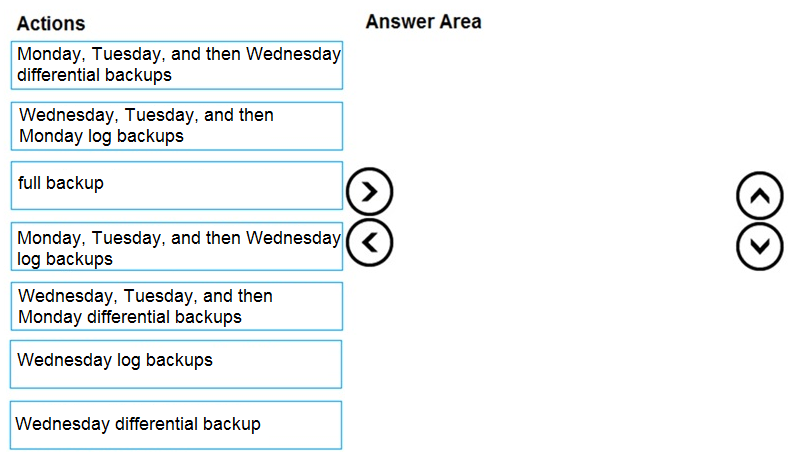
You have SQL Server on an Azure virtual machine that contains a database named DB1. DB1 is 30 TB and has a 1-GB daily rate of change.

You back up the database by using a Microsoft SQL Server Agent job that runs Transact-SQL commands. You perform a weekly full backup on Sunday, daily differential backups at 01:00 in the morning, and transaction log backups every five minutes.

The database fails on Wednesday at 10:00 in the morning.

Which three backups should you restore in sequence? To answer, move the appropriate backups from the list of backups to the answer area and arrange them in the correct order.

Select and Place:

Question 213

Question 214

Open question ↗

You are building a database backup solution for a SQL Server database hosted on an Azure virtual machine.

In the event of an Azure regional outage, you need to be able to restore the database backups. The solution must minimize costs.

Which type of storage accounts should you use for the backups?

  • A.locally-redundant storage (LRS)
  • B.read-access geo-redundant storage (RA-GRS)
  • C.zone-redundant storage (ZRS)
  • D.geo-redundant storage (GRS) ✓

Question 215

Open question ↗

You have SQL Server on Azure virtual machines in an availability group.

You have a database named DB1 that is NOT in the availability group.

You create a full database backup of DB1.

You need to add DB1 to the availability group.

Which restore option should you use on the secondary replica?

  • A.Restore with Recovery
  • B.Restore with Norecovery
  • C.Restore with Standby

Question 216

Open question ↗

You are planning disaster recovery for the failover group of an Azure SQL Database managed instance.

Your company's SLA requires that the database in the failover group become available as quickly as possible if a major outage occurs.

You set the Read/Write failover policy to Automatic.

What are two results of the configuration? Each correct answer presents a complete solution.

NOTE: Each correct selection is worth one point.

  • A.In the event of a datacenter or Azure regional outage, the databases will fail over automatically.
  • B.In the event of an outage, the databases in the primary instance will fail over immediately.
  • C.In the event of an outage, you can selectively fail over individual databases.
  • D.In the event of an outage, you can set a different grace period to fail over each database.
  • E.In the event of an outage, the minimum delay for the databases to fail over in the primary instance will be one hour.

Question 217

Open question ↗

You have an Azure SQL database named DB1.

You need to ensure that DB1 will support automatic failover without data loss if a datacenter fails. The solution must minimize costs.

Which deployment option and pricing tier should you configure?

  • A.Azure SQL Database Premium
  • B.Azure SQL Database serverless
  • C.Azure SQL Database Basic
  • D.Azure SQL Database Standard

Question 218

Open question ↗

Note: This question is part of a series of questions that present the same scenario. Each question in the series contains a unique solution that might meet the stated goals. Some question sets might have more than one correct solution, while others might not have a correct solution.

After you answer a question in this section, you will NOT be able to return to it. As a result, these questions will not appear in the review screen.

You have an Azure SQL database named Sales.

You need to implement disaster recovery for Sales to meet the following requirements:

✑ During normal operations, provide at least two readable copies of Sales.

✑ Ensure that Sales remains available if a datacenter fails.

Solution: You deploy an Azure SQL database that uses the General Purpose service tier and geo-replication.

Does this meet the goal?

  • A.Yes
  • B.No

Question 219

Open question ↗

Note: This question is part of a series of questions that present the same scenario. Each question in the series contains a unique solution that might meet the stated goals. Some question sets might have more than one correct solution, while others might not have a correct solution.

After you answer a question in this section, you will NOT be able to return to it. As a result, these questions will not appear in the review screen.

You have an Azure SQL database named Sales.

You need to implement disaster recovery for Sales to meet the following requirements:

✑ During normal operations, provide at least two readable copies of Sales.

✑ Ensure that Sales remains available if a datacenter fails.

Solution: You deploy an Azure SQL database that uses the Business Critical service tier and Availability Zones.

Does this meet the goal?

  • A.Yes
  • B.No

Question 220

Open question ↗

Note: This question is part of a series of questions that present the same scenario. Each question in the series contains a unique solution that might meet the stated goals. Some question sets might have more than one correct solution, while others might not have a correct solution.

After you answer a question in this section, you will NOT be able to return to it. As a result, these questions will not appear in the review screen.

You have an Azure SQL database named Sales.

You need to implement disaster recovery for Sales to meet the following requirements:

✑ During normal operations, provide at least two readable copies of Sales.

✑ Ensure that Sales remains available if a datacenter fails.

Solution: You deploy an Azure SQL database that uses the General Purpose service tier and failover groups.

Does this meet the goal?

  • A.Yes
  • B.No