FEFreeExamDumps.in

DP-300 Practice Questions — Page 23

Question 221

Open question ↗

You plan to move two 100-GB databases to Azure.

You need to dynamically scale resources consumption based on workloads. The solution must minimize downtime during scaling operations.

What should you use?

  • A.two Azure SQL Databases in an elastic pool ✓
  • B.two databases hosted in SQL Server on an Azure virtual machine
  • C.two databases in an Azure SQL Managed instance
  • D.two single Azure SQL databases

Question 222

Open question ↗

You have an on-premises app named App1 that stores data in an on-premises Microsoft SQL Server 2019 database named DB1.

You plan to deploy additional instances of App1 to separate Azure regions. Each region will have a separate instance of App1 and DB1. The separate instances of

DB1 will sync by using Azure SQL Data Sync.

You need to recommend a database service for the deployment. The solution must minimize administrative effort.

What should you include in the recommendation?

  • A.Azure SQL Managed instance
  • B.Azure SQL Database single database
  • C.Azure Database for PostgreSQL
  • D.SQL Server on Azure virtual machines

Question 223

Open question ↗

Note: This question is part of a series of questions that present the same scenario. Each question in the series contains a unique solution that might meet the stated goals. Some question sets might have more than one correct solution, while others might not have a correct solution.

After you answer a question in this section, you will NOT be able to return to it. As a result, these questions will not appear in the review screen.

You have two Azure SQL Database servers named Server1 and Server2. Each server contains an Azure SQL database named Database1.

You need to restore Database1 from Server1 to Server2. The solution must replace the existing Database1 on Server2.

Solution: From Microsoft SQL Server Management Studio (SSMS), you rename Database1 on Server2 as Database2. From the Azure portal, you create a new database on Server2 by restoring the backup of Database1 from Server1, and then you delete Database2.

Does this meet the goal?
  • A.Yes ✓
  • B.No

Question 224

Open question ↗

You have an Azure subscription that uses a domain named contoso.com.

You have two Azure VMs named DBServer1 and DBServer2. Each of them hosts a default SQL Server instance. DBServer1 is in the East US Azure region and contains a database named DatabaseA. DBServer2 is in the West US Azure region.

DBServer1 has a high volume of data changes and low latency requirements for data writes.

You need to configure a new availability group for DatabaseA. The secondary replica will reside on DBServer2.

What should you do?

  • A.Configure the primary endpoint as TCP://DBServer1.contoso.com:445, configure the secondary endpoint as TCP://DBServer2.contoso.com:445, and set the availability mode to Asynchronous.
  • B.Configure the primary endpoint as TCP://DBServer1.contoso.com:445, configure the secondary endpoint as TCP://DBServer2.contoso.com:445, and set the availability mode to Synchronous.
  • C.Configure the primary endpoint as TCP://DBServer1.contoso.com:5022, configure the secondary endpoint as TCP://DBServer2.contoso.com:5022, and set the availability mode to Asynchronous.
  • D.Configure the primary endpoint as TCP://DBServer1.contoso.com:5022, configure the secondary endpoint as TCP://DBServer2.contoso.com:5022, and set the availability mode to Synchronous.

Question 225

Open question ↗

You have an on-premises multi-tier application named App1 that includes a web tier, an application tier, and a Microsoft SQL Server tier. All the tiers run on Hyper-

V virtual machines.

Your new disaster recovery plan requires that all business-critical applications can be recovered to Azure.

You need to recommend a solution to fail over the database tier of App1 to Azure. The solution must provide the ability to test failover to Azure without affecting the current environment.

What should you include in the recommendation?

  • A.Azure Backup
  • B.Azure Information Protection
  • C.Windows Server Failover Cluster
  • D.Azure Site Recovery

Question 226

Open question ↗

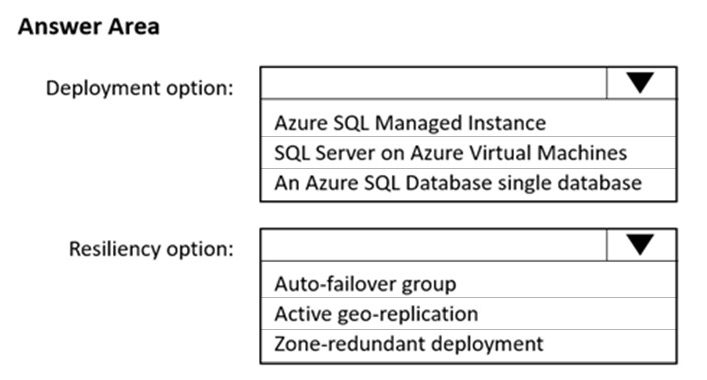
You plan to migrate on-premises Microsoft SQL Server databases to Azure.

You need to identify which deployment and resiliency options meet the following requirements:

✑ Support user-initiated backups.

✑ Support multiple automatically replicated instances across Azure regions.

✑ Minimize administrative effort to implement and maintain business continuity.

What should you identify? To answer, select the appropriate options in the answer area.

NOTE: Each correct selection is worth one point.

Hot Area:

Question 226

Question 227

Open question ↗

You have a new Azure subscription.

You create an Azure SQL Database instance named DB1 on an Azure SQL Database server named Server1.

You need to ensure that users can connect to DB1 in the event of an Azure regional outage. In the event of an outage, applications that connect to DB1 must be able to connect without having to update the connection strings.

Which two actions should you perform? Each correct answer presents part of the solution.

NOTE: Each correct selection is worth one point.

  • A.From the properties of DB1, configure geo-replication.
  • B.From the properties of Server1, add a failover group.
  • C.Create a new Azure SQL Database server named Server2.
  • D.From the properties of Server1, configure retention for DB1.
  • E.Create a new Azure SQL Database instance named DB2.

Question 228

Open question ↗

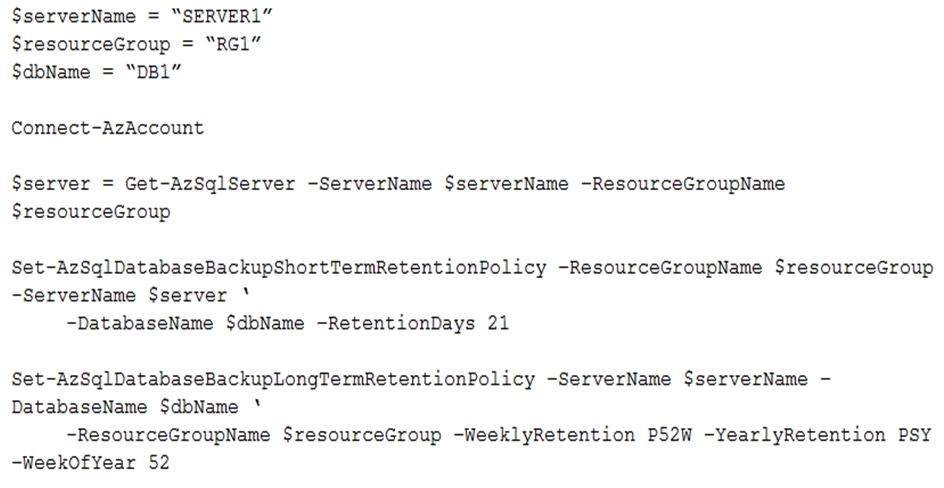
You have an Azure SQL database.

You run the following PowerShell script.

For each of the following statements, select Yes if the statement is true. Otherwise, select No.

NOTE: Each correct selection is worth one point.

Hot Area:

Question 228

Question 229

Open question ↗

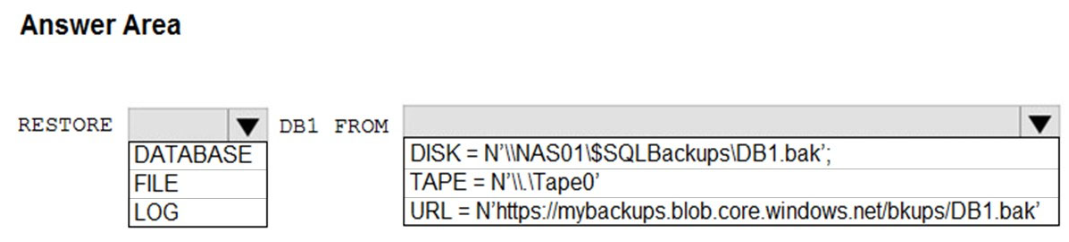
You have an Azure SQL managed instance.

You need to restore a database named DB1 by using Transact-SQL.

Which command should you run? To answer, select the appropriate options in the answer area.

NOTE: Each correct selection is worth one point.

Hot Area:

Question 229

Question 230

Open question ↗

You have an Azure subscription that contains the resources shown in the following table.

You need to back up db1 to mysqlbackups, and then restore the backup to a new database named db2 that is hosted on SQL1. The solution must ensure that db1 is backed up to a stripe set.

Which three Transact-SQL statements should you execute in sequence? To answer, move the appropriate statements from the list of statements to the answer area and arrange them in the correct order.

Select and Place:

Question 230