FEFreeExamDumps.in

DP-300 Practice Questions — Page 3

You have an Azure subscription.

You need to deploy an Azure SQL resource that will support cross database queries by using an Azure Resource Manager (ARM) template.

How should you complete the ARM template? To answer, select the appropriate options in the answer area.

NOTE: Each correct selection is worth one point.

Hot Area:
Question 21

You have the following Azure Resource Manager template.

For each of the following statements, select Yes if the statement is true. Otherwise, select No.

NOTE: Each correct selection is worth one point.

Hot Area:

Question 22

You have an on-premises Microsoft SQL Server 2019 instance that hosts a database named DB1.

You plan to perform an online migration of DB1 to an Azure SQL managed instance by using the Azure Database Migration Service.

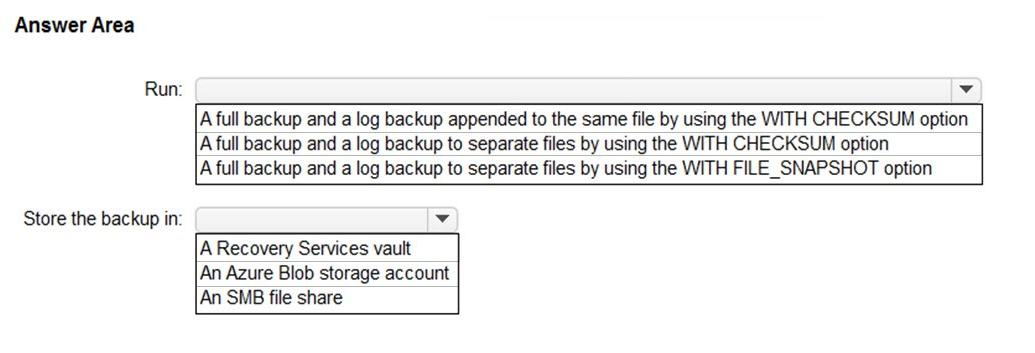
You need to create a backup of DB1 that is accessible to the Azure Database Migration Service.

What should you run for the backup and where should you store the backup? To answer, select the appropriate options in the answer area.

NOTE: Each correct selection is worth one point.

Hot Area:

Question 23

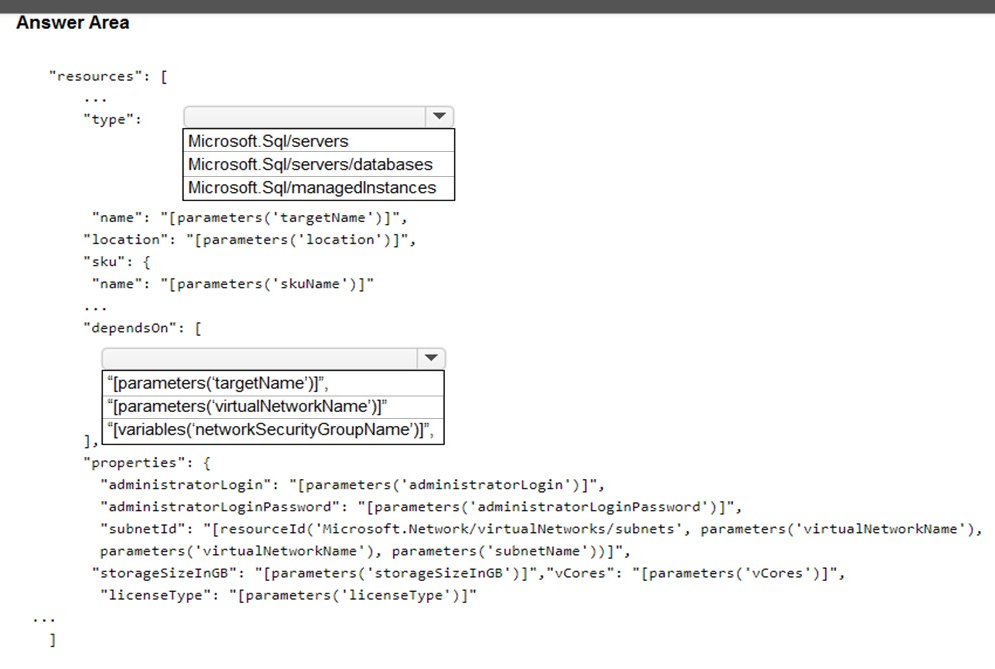
You have an Azure subscription.

You plan to deploy an Azure SQL database by using an Azure Resource Manager template.

How should you complete the template? To answer, select the appropriate options in the answer area.

NOTE: Each correct selection is worth one point.

Hot Area:
Question 24

You have an on-premises Microsoft SQL Server 2019 server that hosts a database named DB1.

You have an Azure subscription that contains an Azure SQL managed instance named SQLMI1 and a virtual network named VNET1. SQLMI1 resides on VNET1.

The on-premises network connects to VNET1 by using an ExpressRoute connection.

You plan to migrate DB1 to SQLMI1 by using Azure Database Migration Service.

You need to configure VNET1 to support the migration.

What should you do?

  • A.Configure service endpoints.
  • B.Configure virtual network peering.
  • C.Deploy an Azure firewall.
  • D.Configure network security groups (NSGs).

You have an on-premises Microsoft SQL server that uses the FileTables and Filestream features.

You plan to migrate to Azure SQL.

Which service should you use?

  • A.Azure SQL Database
  • B.SQL Server on an Azure Virtual Machine
  • C.Azure SQL Managed Instance
  • D.Azure Database for MySQL

You need to migrate an on-premises Microsoft SQL Server database to Azure SQL Database. The solution must minimize downtime.

What should you do?

  • A.Configure Transaction Log Shipping.
  • B.Implement Always On availability groups.
  • C.Configure transactional replication.
  • D.Import a BACPAC.

You have an Azure SQL database named DB1.

You have a table name Table1 that has 20 columns of type CHAR(400). Row compression for Table1 is enabled.

During a database audit, you discover that none of the fields contain more than 150 characters.

You need to ensure that you can apply page compression to Table1.

What should you do?

  • A.Configure the columns as sparse.
  • B.Change the column type to NVARCHAR(MAX).
  • C.Change the column type to VARCHAR(MAX).
  • D.Change the column type to VARCHAR(200).

You have an on-premises Microsoft SQL Server named SQL1 that hosts five databases.

You need to migrate the databases to an Azure SQL managed instance. The solution must minimize downtime and prevent data loss.

What should you use?

  • A.Always On availability groups
  • B.Backup and Restore
  • C.log shipping
  • D.Database Migration Assistant

You have an Azure subscription that contains an Azure SQL database. The database contains a table named tablet that uses partitioned columnstores.

You need to configure table1 to meet the following requirements:

• Each partition must be compressed.

• The compression ratio must be maximized.

• You must be able to index the compressed data.

What should you use?

  • A.page compression
  • B.columnstore compression
  • C.GZIP compression
  • D.columnstore archival compression